
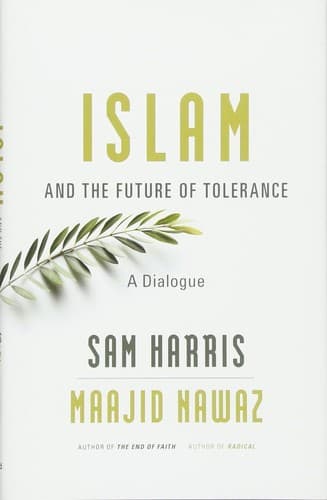
Islam and the Future of Tolerance: A Dialogue
الإسلام ومستقبل التسامح: حوار
L'islam et l'avenir de la tolérance : Un dialogue
Editorial summary
This collaborative work presents a sustained dialogue between Sam Harris, a prominent atheist neuroscientist, and Maajid Nawaz, a former Islamic extremist turned liberal Muslim reformer. The text explores possibilities for Islamic reform and the challenges of religious tolerance in contemporary Western societies, offering a model for constructive engagement between secular and religious worldviews on contentious theological and political questions.
The dialogue format allows both authors to articulate their positions while responding to challenges in real time. Harris maintains his characteristic critique of religious fundamentalism while acknowledging distinctions between Muslims as individuals and Islamic doctrine as a belief system. He presses Nawaz on whether liberal interpretations of Islam can gain sufficient traction against literalist readings of scripture. Nawaz, drawing on his personal journey from extremism and his expertise in Islamic theology, argues that Islam contains resources for pluralistic interpretation, though he acknowledges the current dominance of conservative and fundamentalist voices within Muslim communities.
Central to their exchange is the question of scriptural interpretation and religious authority. Nawaz contends that the Quran, like other religious texts, requires historical contextualization and can support multiple readings. He distinguishes between Islam as a religion, Islamism as a political ideology, and jihadism as violent extremism, arguing that conflating these categories hinders productive discourse. Harris, while sympathetic to reform efforts, expresses skepticism about whether liberal theology can compete with the apparent clarity of literalist interpretations.
The work engages critically with both Western liberal assumptions about religion and conservative Islamic theology. Against those who deny any connection between Islamic doctrine and extremist violence, the authors acknowledge textual and theological challenges while rejecting essentialist views of Islam as inherently violent. Their discussion addresses practical concerns about immigration, free speech, and the role of criticism in promoting religious reform.
The dialogue's significance lies in modeling respectful disagreement on sensitive theological and political topics. Rather than seeking complete consensus, Harris and Nawaz demonstrate how individuals with fundamentally different worldviews can engage productively on questions of religious belief, practice, and reform. Their exchange suggests that honest dialogue about difficult theological questions, including the existence and nature of God, remains possible even across significant ideological divides, though such conversations require mutual respect and intellectual courage from all participants.
Argument formulations engaged
Related works
Harris, Sam (2015). Islam and the Future of Tolerance: A Dialogue. Harvard University Press.
@book{islam-and-the-future-of-tolerance-a-dial,
  author    = {Harris, Sam},
  title     = {Islam and the Future of Tolerance: A Dialogue},
  year      = {2015},
  publisher = {Harvard University Press},
  url       = {https://god-database.com/en/works/islam-and-the-future-of-tolerance-a-dialogue-2015}
}