
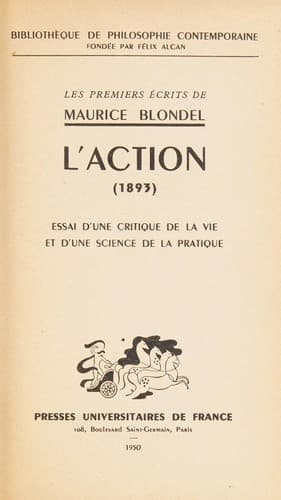
L'Action
العمل
Editorial summary
Maurice Blondel's "L'Action" (1893) represents a groundbreaking philosophical attempt to demonstrate the necessity of the supernatural through an immanent analysis of human action. Writing against the prevailing rationalist and positivist currents of late nineteenth-century France, Blondel develops a dialectical method that traces the internal logic of human willing to reveal an inherent openness to transcendence. His work challenges both the secular philosophy that would exclude religious questions from serious intellectual consideration and the defensive Catholic theology that relied primarily on external proofs and authority.
The monograph unfolds through a rigorous phenomenology of action, beginning with the fundamental question of whether human life has meaning. Blondel argues that even the nihilist who denies meaning must act, and in acting, implicitly affirms something beyond mere negation. Through careful analysis, he demonstrates that human action contains an inexhaustible dynamism—what he terms "volonté voulante" (willing will)—that perpetually exceeds its concrete realizations or "volonté voulue" (willed will). This disproportion between aspiration and achievement drives consciousness toward ever-expanding horizons of meaning and value.
Blondel's method proves particularly innovative in its refusal to impose religious conclusions from without. Instead, he shows how the logic of action itself leads to what he calls "the necessary hypothesis of the supernatural." Human beings discover within their own striving an orientation toward the infinite that cannot be satisfied by any finite object or achievement. This discovery emerges not through abstract speculation but through lived experience reflectively analyzed. The supernatural appears not as an alien imposition but as the secret desire animating all human endeavor.
The work's significance for debates about God lies in its methodological breakthrough. Against both rationalist reduction and fideist retreat, Blondel establishes philosophy of action as a legitimate approach to ultimate questions. He demonstrates that the question of God arises from within the structure of human existence itself, not merely from external revelation or logical proofs. This immanent apologetics influenced subsequent thinkers from Henri de Lubac to Karl Rahner, shaping twentieth-century attempts to correlate human experience with divine transcendence. "L'Action" thus inaugurates a new style of philosophical theology that takes seriously both modern subjectivity and traditional religious claims, showing their mutual implication rather than opposition.
Argument formulations engaged
Related works
Blondel, Maurice (1893). L'Action.
@book{laction-1893,
  author    = {Blondel, Maurice},
  title     = {L'Action},
  year      = {1893},
  url       = {https://god-database.com/en/works/laction-1893}
}