
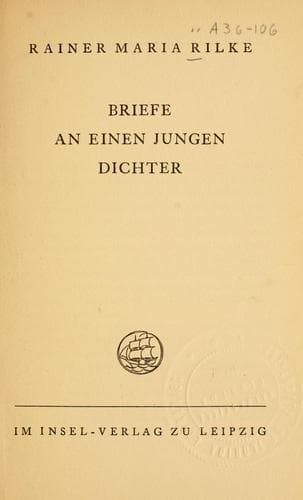
Letters to a Young Poet
رسائل إلى شاعر شاب
Lettres à un jeune poète
Editorial summary
Rainer Maria Rilke's Letters to a Young Poet addresses fundamental questions about human existence, creativity, and the divine through a series of ten letters written between 1903 and 1908 to Franz Xaver Kappus, an aspiring poet. While not a systematic theological treatise, this correspondence articulates a distinctive perspective on spirituality that resists both conventional religious orthodoxy and secular materialism, offering instead a deeply personal, aesthetic approach to understanding the sacred dimensions of human experience.
Rilke develops a conception of God that emerges through lived experience rather than doctrinal belief. He counsels patience with spiritual questions, arguing that individuals must live their way into answers rather than seeking immediate intellectual resolution. This methodological stance places him in opposition to both rationalist theology, which attempts to prove God's existence through logical argumentation, and dogmatic religion, which demands adherence to established creeds. Instead, Rilke advocates for what might be termed an experiential theology grounded in solitude, artistic creation, and careful attention to inner life.
Central to Rilke's spiritual vision is the concept of transformation. He presents human existence as a process of becoming, where encounters with beauty, suffering, and love serve as occasions for spiritual development. This process-oriented understanding of spirituality aligns with certain mystical traditions while maintaining a modernist sensibility that acknowledges the difficulties of faith in an increasingly secular age. Rilke neither dismisses traditional religious frameworks nor fully embraces them, instead carving out a middle path that honors the sacred while remaining suspicious of institutionalized religion.
The work's contribution to debates about God lies in its articulation of a post-traditional spirituality that maintains reverence for the numinous while rejecting conventional theological categories. Rilke's emphasis on uncertainty, patience, and personal experience as pathways to spiritual understanding anticipates later twentieth-century developments in existential theology and religious phenomenology. His insistence that questions about God must be lived rather than solved offers an alternative to both confident atheism and unreflective faith.
Through its literary form, Letters to a Young Poet demonstrates how aesthetic experience might serve as a mode of spiritual inquiry. Rilke's poetic sensibility infuses his spiritual reflections, suggesting that artistic creation itself constitutes a form of prayer or meditation. This integration of aesthetic and spiritual concerns positions the work as a significant contribution to modern discussions about the relationship between art, meaning, and transcendence.
Rilke, Rainer Maria (1929). Letters to a Young Poet. Liveright.
@book{letters-to-a-young-poet-1929,
  author    = {Rilke, Rainer Maria},
  title     = {Letters to a Young Poet},
  year      = {1929},
  publisher = {Liveright},
  url       = {https://god-database.com/en/works/letters-to-a-young-poet-1929}
}