
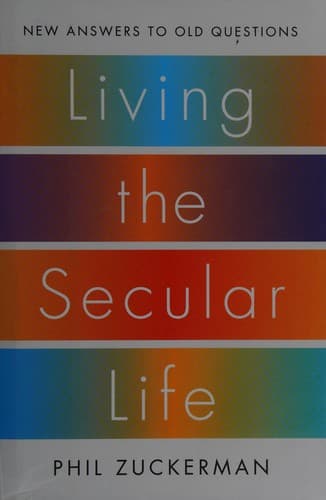
Living the Secular Life: New Answers to Old Questions
عيش الحياة العلمانية: إجابات جديدة لأسئلة قديمة
Vivre la vie séculière : nouvelles réponses aux anciennes questions
Editorial summary
Living the Secular Life: New Answers to Old Questions presents Phil Zuckerman's sociological investigation into how secular Americans construct meaningful, ethical lives without religious belief. Drawing on extensive qualitative research including in-depth interviews with nonreligious individuals across the United States, Zuckerman challenges prevalent assumptions that morality, community, and existential purpose require religious foundations. The work functions as both an empirical study and an implicit argument against theistic claims about the necessity of God for human flourishing.
Zuckerman employs ethnographic methods to document how secular individuals navigate traditionally religious domains: finding meaning, raising children, facing death, building community, and developing ethical frameworks. His subjects articulate coherent worldviews grounded in reason, empathy, and naturalistic understanding rather than supernatural belief. The author identifies common patterns among secular Americans, including emphasis on critical thinking, acceptance of uncertainty, commitment to this-worldly concerns, and derivation of meaning from human relationships and experiences rather than divine purpose.
The work directly counters religious apologetics that posit secular life as inherently nihilistic or amoral. Against claims by religious conservatives that atheism leads to societal decay, Zuckerman presents evidence that secular individuals exhibit strong ethical commitments, often scoring higher than religious populations on measures of social trust, charitable giving, and support for human rights. He documents thriving secular communities in places like Scandinavia and the Pacific Northwest, demonstrating that societies with low religiosity can maintain high levels of social cohesion and individual wellbeing.
Methodologically, Zuckerman combines sociological analysis with philosophical reflection, though his primary contribution remains empirical. He situates his findings within broader secularization theory while avoiding deterministic predictions about religion's future. The work engages with critics like Charles Taylor who argue secular life lacks transcendent meaning, offering lived examples as counterevidence.
The monograph's significance lies in its systematic documentation of successful secular living, providing empirical grounding for philosophical arguments about morality without God. By presenting secular life as a viable, fulfilling alternative to religious existence, Zuckerman implicitly supports naturalistic worldviews while explicitly focusing on descriptive rather than prescriptive claims. His work contributes to understanding secularization not merely as religious decline but as the emergence of alternative meaning systems that function effectively without theistic foundations.
Argument formulations engaged
Zuckerman, Phil (2014). Living the Secular Life: New Answers to Old Questions. Penguin Press.
@book{living-the-secular-life-new-answers-to-o,
  author    = {Zuckerman, Phil},
  title     = {Living the Secular Life: New Answers to Old Questions},
  year      = {2014},
  publisher = {Penguin Press},
  url       = {https://god-database.com/en/works/living-the-secular-life-new-answers-to-old-questions-2014}
}