
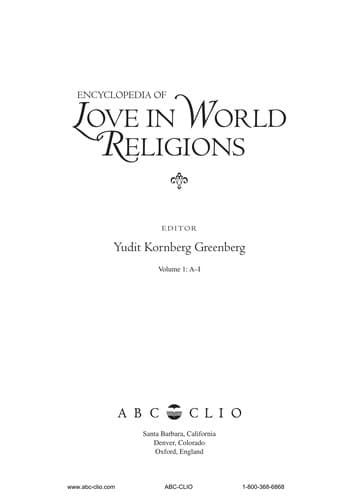
Love in World Religions
الحب في أديان العالم
L'Amour dans les religions du monde
The concept of love, examined across the world's major religious traditions, reveals a shared yet diversely expressed spiritual and ethical core that cuts across doctrinal boundaries.
Editorial summary
This monograph examines how love functions as a central concept across major religious traditions, offering a comparative analysis that illuminates both universal themes and particular expressions of divine-human relationships. Greenberg approaches her subject through systematic comparison of Judaism, Christianity, Islam, Hinduism, and Buddhism, investigating how each tradition conceptualizes love between the divine and human beings, among humans themselves, and toward the created order.
The work employs a phenomenological method that respects each tradition's internal logic while identifying structural similarities and differences. Greenberg demonstrates that while all examined traditions position love as fundamental to religious life, they articulate distinct theologies of love that reflect their broader metaphysical commitments. In theistic traditions, she traces how divine love serves as both model and source for human love, examining classical texts alongside mystical writings to reveal tensions between transcendent and immanent conceptions of divine affection. Her analysis of non-theistic Buddhism presents love as compassion arising from enlightened awareness rather than personal deity, offering important contrasts to Western assumptions about religious love requiring a divine subject.
Particularly significant is Greenberg's treatment of reciprocity in divine-human love relationships. She explores how different traditions navigate the asymmetry between infinite divine love and finite human response, analyzing theological strategies from surrender and devotion to contemplation and ethical action. The comparative framework reveals how concepts of divine love shape religious anthropology, ethics, and soteriology within each tradition. Her examination of mystical texts across traditions uncovers remarkable convergences in experiential descriptions of divine love, even where theological frameworks diverge substantially.
The monograph contributes to religious dialogue by demonstrating how love serves as both a bridge and boundary between traditions. While avoiding reductionism or false harmonization, Greenberg identifies love as a category enabling meaningful interreligious conversation about ultimate reality and human flourishing. Her work challenges purely rationalistic approaches to religious diversity by highlighting the affective and experiential dimensions of religious commitment. For scholars of religion, the study provides a sophisticated model for comparative analysis that maintains rigor while remaining sensitive to each tradition's particularity. The work ultimately suggests that understanding how religions conceptualize and cultivate love remains essential for grasping their transformative power in human life.
Structured analysis
Argument formulations engaged
Related works
Greenberg, Yudit Kornberg (2008). Love in World Religions.
@book{love-in-world-religions,
  author    = {Greenberg, Yudit Kornberg},
  title     = {Love in World Religions},
  year      = {2008},
  url       = {https://god-database.com/en/works/love-in-world-religions}
}