
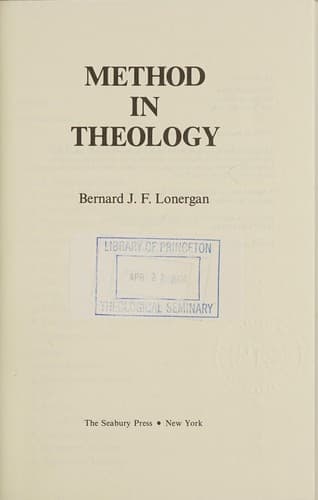
Method in Theology
المنهج في اللاهوت
Méthode en théologie
Editorial summary
Bernard Lonergan's Method in Theology represents a systematic attempt to establish theology as a methodical discipline comparable to the empirical sciences. Writing in the wake of Vatican II's call for theological renewal, Lonergan addresses the fragmentation of theological discourse by proposing a unified methodological framework that respects both the transcendent dimension of religious experience and the demands of critical scholarship.
The work divides theological activity into eight functional specialties arranged in two phases. The first phase moves from data to foundations through research, interpretation, history, and dialectic. The second phase proceeds from foundations to communications through doctrines, systematics, and communications. This structure reflects Lonergan's fundamental distinction between the mediating phase, which encounters the past, and the mediated phase, which addresses the present and future. Each specialty corresponds to a distinct task within the theological enterprise while remaining dynamically related to the others.
Central to Lonergan's project is his cognitional theory, which grounds theological method in an analysis of human consciousness. He identifies four levels of conscious operation: experiencing, understanding, judging, and deciding. These operations yield a transcendental method that undergirds all authentic knowing. For theology specifically, Lonergan emphasizes the crucial role of conversion - intellectual, moral, and religious - in establishing the horizon within which theological work proceeds. Religious conversion, understood as being grasped by ultimate concern, provides the foundational reality that theology seeks to understand and articulate.
The work engages critically with both traditional scholasticism and contemporary empiricism. Against neo-scholastic approaches, Lonergan argues that theology cannot remain content with logical deduction from fixed premises but must engage historical consciousness and cultural pluralism. Against reductive empiricism, he maintains that authentic objectivity requires attention to the full range of human experience, including religious experience. His notion of the "transcendental precepts" - be attentive, be intelligent, be reasonable, be responsible - offers a framework for critical realism that avoids both naive objectivism and radical relativism.
Lonergan's contribution to debates about God lies primarily in his methodological sophistication. Rather than offering direct arguments for theism, he provides a framework within which religious claims can be critically examined and constructively developed. His emphasis on conversion as foundational for theology and his integration of subjective authenticity with objective method offer resources for understanding how religious knowledge claims function within broader patterns of human knowing.
Argument formulations engaged
Lonergan, Bernard (1972). Method in Theology. University of Toronto Press.
@book{method-in-theology-1972,
  author    = {Lonergan, Bernard},
  title     = {Method in Theology},
  year      = {1972},
  publisher = {University of Toronto Press},
  url       = {https://god-database.com/en/works/method-in-theology-1972}
}