
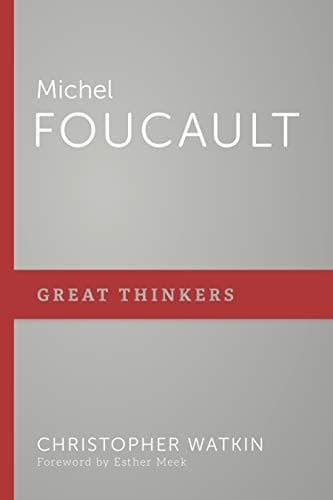
Michel Foucault
ميشيل فوكو
Editorial summary
Christopher Watkin's monograph offers a comprehensive analysis of Michel Foucault's philosophical project and its implications for theological discourse. The work examines how Foucault's genealogical method and critique of power structures challenge traditional theological frameworks while paradoxically opening new avenues for understanding religious thought and practice.
Watkin demonstrates that Foucault's approach to Christianity operates through a distinctive archaeological and genealogical lens that neither affirms nor directly negates theological claims. Instead, Foucault investigates the historical conditions that made certain religious discourses possible and examines how Christian practices of confession, pastoral power, and techniques of the self shaped Western subjectivity. The monograph carefully traces Foucault's engagement with early Christian texts, particularly his late lectures on the government of self and others, revealing a nuanced appreciation for Christian ascetic practices as technologies of self-formation rather than mere instruments of repression.
The study highlights Foucault's complex relationship with religious themes, showing how his work on discipline, sexuality, and biopower consistently returns to Christian sources not to debunk religious belief but to understand how Christian institutions and practices produced specific forms of knowledge and subjectivity. Watkin argues that Foucault's genealogies of confession and pastoral power illuminate how Christian techniques of truth-telling and soul-direction became secularized in modern psychiatric, medical, and governmental practices.
Significantly, Watkin positions Foucault's work as neither straightforwardly secular nor crypto-theological but as occupying a liminal space that destabilizes conventional boundaries between religious and secular discourse. The monograph engages with contemporary theological responses to Foucault, including both critical rejections and creative appropriations of his insights for constructive theology. Watkin particularly emphasizes how Foucault's late work on parrhesia and care of the self resonates with certain theological concerns about spiritual practice and ethical formation.
The monograph contributes to the God debate by demonstrating how Foucault's historical method offers tools for analyzing religious discourse without reducing it to ideology or false consciousness. Watkin shows that Foucault's approach enables scholars to examine the productive power of religious practices and institutions in shaping human subjects, thereby moving beyond simplistic narratives of secularization or religious decline. This perspective proves valuable for theologians seeking to understand their own tradition's historical contingency while maintaining its contemporary relevance.
Argument formulations engaged
Watkin, Christopher (2017). Michel Foucault. P & R Publishing.
@book{michel-foucault-2017,
  author    = {Watkin, Christopher},
  title     = {Michel Foucault},
  year      = {2017},
  publisher = {P & R Publishing},
  url       = {https://god-database.com/en/works/michel-foucault-2017}
}