
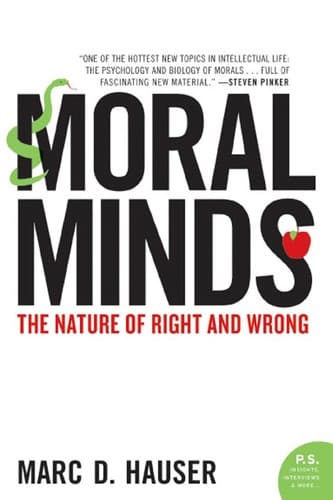
Moral Minds.. The Nature of Right and Wrong
العقول الأخلاقية.. طبيعة الصواب والخطأ
Les esprits moraux.. La nature du bien et du mal
Human moral judgment is grounded in an innate, universal moral faculty shaped by evolution rather than by explicit religious instruction or cultural transmission alone.
Editorial summary
Marc Hauser's "Moral Minds: The Nature of Right and Wrong" presents a naturalistic account of human morality grounded in evolutionary biology and cognitive science. Drawing on extensive empirical research, Hauser argues that humans possess an innate moral faculty analogous to Chomsky's language faculty—a universal moral grammar hardwired into the brain through evolutionary processes. This work contributes to debates about God by offering a thoroughly secular explanation for moral phenomena traditionally attributed to divine origins or religious instruction.
The monograph systematically challenges theistic accounts of morality that ground ethics in divine command or religious revelation. Hauser marshals evidence from developmental psychology, primatology, neuroscience, and cross-cultural studies to demonstrate that moral judgments emerge from unconscious, automatic processes rooted in our evolutionary heritage rather than from conscious reasoning or religious teaching. His experimental data reveals surprising moral universals across diverse cultures and religions, suggesting that core moral intuitions precede and transcend particular theological frameworks.
Central to Hauser's argument is the claim that morality represents a biological adaptation shaped by natural selection to facilitate cooperation within social groups. He examines how emotions, particularly empathy and disgust, interface with cognitive systems to generate moral judgments. This naturalistic framework explains moral sentiments without recourse to transcendent sources, positioning itself against both divine command theory and religiously-grounded natural law traditions. The work engages consciousness arguments by exploring how moral intuitions often operate below the threshold of awareness, challenging views that link morality to rational deliberation or spiritual discernment.
The philosophical implications extend beyond mere description. By grounding morality in evolved neural mechanisms, Hauser's account suggests that religious moral teachings represent post-hoc rationalizations of pre-existing intuitions rather than their source. This reverses traditional apologetic arguments that cite universal moral awareness as evidence for God's existence. The work exemplifies the philosophy of science approach by building philosophical conclusions atop empirical foundations, demonstrating how scientific investigation can address questions traditionally reserved for theology.
While Hauser presents his findings as descriptive science, the work carries significant implications for religious worldviews. His naturalistic explanation for moral phenomena removes a traditional argument for theism while suggesting that religious moral codes derive their persuasive power from alignment with evolved intuitions rather than divine authority. This contribution to the secularization of ethics represents a significant challenge to theistic frameworks that ground morality in transcendent sources.
Structured analysis
Structure of the work
Argument formulations engaged
Hauser, Marc D. (2006). Moral Minds.. The Nature of Right and Wrong.
@book{moral-minds-the-nature-of-right-and-wron,
  author    = {Hauser, Marc D.},
  title     = {Moral Minds.. The Nature of Right and Wrong},
  year      = {2006},
  url       = {https://god-database.com/en/works/moral-minds-the-nature-of-right-and-wrong}
}