
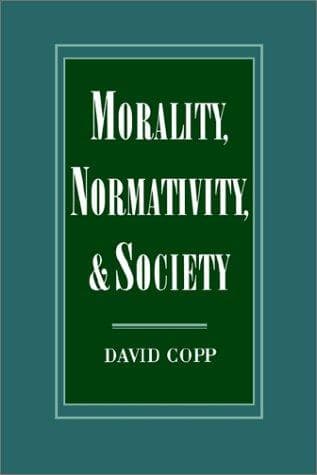
Morality, Normativity, and Society
الأخلاق والمعيارية والمجتمع
Moralité, normativité et société
Editorial summary
David Copp's "Morality, Normativity, and Society" develops a sophisticated naturalistic theory of morality that, while not explicitly focused on theological questions, carries significant implications for debates about the relationship between God and ethics. The work advances a society-centered theory of morality that grounds moral truths in facts about what moral codes would best serve societal needs, thereby offering an alternative to divine command theories and other supernaturalist accounts of moral authority.
Copp argues that morality derives its normativity from its social function rather than from divine commands or transcendent moral facts. His theory posits that moral propositions express truths relative to moral standards, where these standards gain their authority through their role in enabling societal cooperation and flourishing. This approach directly challenges theistic metaethical theories that ground moral obligation in God's will or nature. By providing a naturalistic account of how moral facts can exist and bind us without supernatural foundations, Copp offers resources for those seeking to defend objective morality within a secular framework.
The work engages critically with both moral relativism and moral realism, carving out a distinctive position that maintains moral objectivity while denying that moral facts float free of human social arrangements. Copp's methodology combines conceptual analysis with empirical considerations about human psychology and social organization. He examines how moral codes function to solve coordination problems and enable beneficial cooperation, suggesting that the most justified moral standards are those that would best serve these societal needs if widely accepted.
While Copp does not explicitly argue against theism, his naturalistic approach to morality removes one traditional argument for God's existence - the need for a divine lawgiver to ground moral obligations. His theory demonstrates how robust moral realism can be maintained without theological commitments, showing that moral facts can be grounded in natural facts about human societies and their needs. This contribution is particularly significant for secular ethicists seeking to answer the challenge that without God, morality becomes merely subjective or relative. By providing a detailed account of how moral normativity emerges from social functions rather than divine commands, Copp's work strengthens the philosophical resources available to those defending non-theistic approaches to ethics and metaethics.
Argument formulations engaged
Copp, David (1995). Morality, Normativity, and Society.
@book{morality-normativity-and-society-1995,
  author    = {Copp, David},
  title     = {Morality, Normativity, and Society},
  year      = {1995},
  url       = {https://god-database.com/en/works/morality-normativity-and-society-1995}
}