
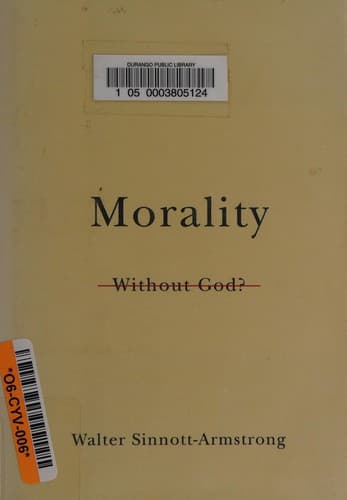
Morality Without God?
الأخلاق بدون الله؟
Moralité sans Dieu ?
Editorial summary
This monograph presents a systematic defense of secular morality, arguing that ethical values and moral knowledge do not require religious foundations. Sinnott-Armstrong develops his position through careful engagement with theistic moral arguments, offering a comprehensive account of how morality can function independently of divine command or religious belief.
The work proceeds through several interconnected arguments. First, Sinnott-Armstrong examines and rejects various formulations of divine command theory, demonstrating that attempts to ground morality in God's will face insurmountable philosophical difficulties. He analyzes the Euthyphro dilemma and its modern variants, arguing that theistic responses fail to resolve the fundamental tension between moral autonomy and divine authority. Second, he addresses epistemological concerns about moral knowledge, contending that secular approaches provide more reliable methods for moral reasoning than religious revelation or scripture. Third, he responds to the common charge that atheism leads to moral nihilism, presenting evidence from psychology and sociology that moral behavior does not correlate with religious belief.
The author employs analytical philosophical methods throughout, combining conceptual analysis with empirical evidence from moral psychology and comparative ethics. His approach is notably even-handed, acknowledging the sophistication of contemporary theistic ethics while maintaining that secular alternatives prove more defensible. He engages extensively with work by Robert Adams, Philip Quinn, and other prominent divine command theorists, as well as drawing on secular moral philosophers from Kant to contemporary virtue ethicists.
The monograph's significance lies in its comprehensive treatment of a perennial question in philosophy of religion. While many works address either metaethical theory or practical moral implications of atheism, Sinnott-Armstrong integrates both dimensions into a unified account. His argument contributes to broader debates about the relationship between religion and morality, challenging the widespread assumption that ethics requires religious grounding. The work also advances discussions in moral epistemology by defending a moderate moral realism compatible with naturalism.
The text proves particularly valuable for its accessibility to non-specialists while maintaining philosophical rigor. Sinnott-Armstrong addresses common misconceptions about secular ethics and provides practical responses to religious challenges regarding morality. His analysis of how societies can maintain moral standards without religious foundations offers insights relevant to increasingly secular contemporary contexts, making this work significant for both theoretical philosophy and practical ethics.
Argument formulations engaged
Related works
Sinnott-Armstrong, Walter (2009). Morality Without God?. Oxford University Press.
@book{morality-without-god-2009,
  author    = {Sinnott-Armstrong, Walter},
  title     = {Morality Without God?},
  year      = {2009},
  publisher = {Oxford University Press},
  url       = {https://god-database.com/en/works/morality-without-god-2009}
}