
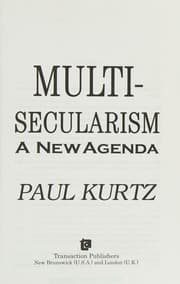
Multi-Secularism: A New Agenda
تعددية العلمانية: أجندة جديدة
Multi-Sécularisme : Un Nouvel Agenda
Editorial summary
Paul Kurtz's "Multi-Secularism: A New Agenda" presents a comprehensive philosophical framework for contemporary secular humanism that extends beyond traditional atheistic critiques of religion. The monograph develops what Kurtz terms "multi-secularism," a pluralistic approach to secular values that addresses the diverse challenges facing post-religious societies while engaging constructively with the persistence of religious belief in modern contexts.
The work distinguishes itself from conventional secularist literature by moving beyond mere rejection of theological claims to propose positive ethical and political alternatives. Kurtz argues that secularism must evolve from its historical role as religion's opponent into a constructive worldview capable of addressing human needs traditionally met by religious institutions. His analysis identifies multiple domains where secular principles require development: ethics without divine command theory, meaning-making absent transcendent purpose, community formation without religious congregation, and moral education independent of theological frameworks.
Central to Kurtz's argument is his critique of what he perceives as the limitations of both militant atheism and accommodationist approaches to religion. He contends that aggressive anti-theism alienates potential allies while failing to provide adequate substitutes for religion's social functions, whereas excessive accommodation compromises core secular principles. His multi-secular approach instead advocates for principled coexistence based on shared humanistic values while maintaining intellectual integrity regarding supernatural claims.
The monograph engages critically with both religious apologists and fellow secularists, particularly addressing communitarian critics who argue that secular worldviews lack the social cohesion and moral authority of religious traditions. Kurtz responds by developing a notion of "ethical culture" that grounds moral obligations in human experience and rational reflection rather than divine revelation. He examines successful secular institutions and movements to demonstrate the viability of non-religious approaches to education, ethics, and community building.
Kurtz's contribution to debates about God lies primarily in his reframing of secularism from a negative stance toward religion to a positive program for human flourishing. His work challenges both theistic assumptions about the necessity of religious belief for ethical life and simplistic atheistic dismissals of religion's cultural significance. The multi-secular framework he proposes offers a sophisticated alternative to binary debates between theism and atheism, suggesting that the future of secularism depends on its ability to address existential and social needs without recourse to supernatural beliefs.
Argument formulations engaged
Kurtz, Paul (2010). Multi-Secularism: A New Agenda. Transaction Publishers.
@book{multi-secularism-a-new-agenda-2010,
  author    = {Kurtz, Paul},
  title     = {Multi-Secularism: A New Agenda},
  year      = {2010},
  publisher = {Transaction Publishers},
  url       = {https://god-database.com/en/works/multi-secularism-a-new-agenda-2010}
}