
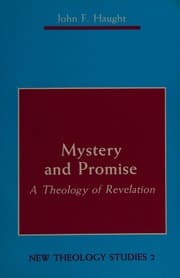
Mystery and Promise: A Theology of Revelation
الغموض والوعد: لاهوت الوحي
Mystère et Promesse : Une Théologie de la Révélation
Editorial summary
John F. Haught's "Mystery and Promise: A Theology of Revelation" presents a sophisticated theological framework that reconceives divine revelation as an ongoing cosmic and historical process rather than a static deposit of information. Writing from within the Catholic theological tradition while engaging extensively with process thought and evolutionary theory, Haught develops an understanding of God as the ultimate source of novelty and futurity in the universe.
The work directly challenges both fundamentalist conceptions of revelation as propositional truths and modernist reductions that would eliminate mystery from theological discourse. Haught argues that authentic revelation necessarily involves an element of hiddenness or mystery that resists complete conceptualization. This mystery, however, functions not as an obstacle to knowledge but as an invitation to deeper participation in reality's unfolding. Against theological positions that emphasize divine immutability, Haught presents God as intimately involved in temporal processes, revealing divine nature through the emergence of genuine novelty in cosmic evolution and human history.
Central to Haught's argument is his appropriation of process philosophy, particularly the work of Alfred North Whitehead, to articulate how God acts persuasively rather than coercively in the world. This allows him to address the perennial problem of divine action in nature without violating scientific understandings of causation. Revelation occurs not through supernatural interruptions but through God's continuous luring of creation toward greater complexity, consciousness, and communion. Haught particularly emphasizes how evolutionary science, rather than threatening religious faith, actually deepens appreciation for divine creativity operating over vast temporal scales.
The text engages critically with both scientific materialism and classical theism, positioning itself as a mediating position that takes seriously both scientific discoveries and religious experience. Haught contends that reducing reality to purely material processes eliminates the dimension of promise that gives meaning to cosmic and human development. Simultaneously, he critiques traditional theologies that separate God from temporal processes, arguing such views cannot adequately account for genuine novelty or human freedom.
This work's significance lies in its systematic integration of contemporary science with theological reflection, offering a vision of God that remains intellectually credible while preserving religious meaning. Haught's emphasis on futurity and promise provides resources for ecological theology and inter-religious dialogue, suggesting that revelation remains open-ended rather than completed in past events.
Argument formulations engaged
Haught, John F. (1993). Mystery and Promise: A Theology of Revelation. Liturgical Press.
@book{mystery-and-promise-a-theology-of-revela,
  author    = {Haught, John F.},
  title     = {Mystery and Promise: A Theology of Revelation},
  year      = {1993},
  publisher = {Liturgical Press},
  url       = {https://god-database.com/en/works/mystery-and-promise-a-theology-of-revelation-1993}
}