
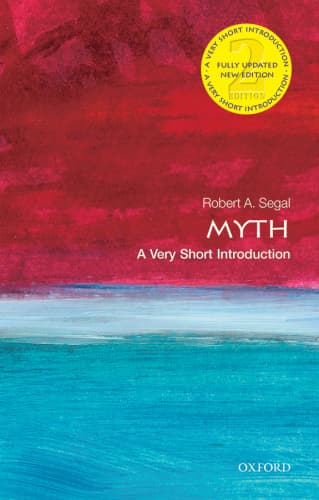
Myth: A Very Short Introduction
الأسطورة: مقدمة قصيرة جداً
Mythe : Une Très Brève Introduction
Editorial summary
This monograph examines myth as a cultural and intellectual phenomenon, analyzing various theoretical approaches to understanding mythological narratives across cultures and historical periods. Segal structures his investigation around competing definitions and interpretations of myth, demonstrating how different scholarly frameworks yield distinct insights into the relationship between mythological thinking and religious belief.
The work surveys major theoretical positions from the nineteenth century onward, including evolutionary, functionalist, structuralist, and psychoanalytic approaches. Segal examines how early anthropologists like Edward Tylor and James Frazer positioned myth as primitive science, destined to be replaced by rational thought, while later functionalists such as Bronisław Malinowski argued that myths serve ongoing social purposes regardless of scientific advancement. The analysis extends to structuralist interpretations, particularly those of Claude Lévi-Strauss, which treat myths as systems encoding fundamental binary oppositions in human thought.
Central to Segal's discussion is the question of how myths relate to religious truth claims. He explores whether mythological narratives must be understood literally or symbolically, and how this distinction affects their viability in modern contexts. The work addresses the challenge posed by scientific worldviews to traditional mythological explanations of natural phenomena, while also examining arguments that myths address existential and moral dimensions beyond empirical science's scope.
Segal engages critically with scholars who attempt to preserve myth's relevance through demythologization or remythologization, including Rudolf Bultmann's program of extracting existential meaning from biblical narratives stripped of supernatural elements. The monograph also considers psychological interpretations, particularly those of Carl Jung and Joseph Campbell, which treat myths as expressions of universal human experiences and archetypal patterns.
The work's significance for debates about God lies in its systematic analysis of how mythological thinking relates to religious belief and practice. Segal demonstrates that the question of myth's truth status directly impacts arguments about divine reality and religious knowledge. By examining how different cultures and intellectual traditions have understood the relationship between mythological narratives and ultimate reality, the monograph provides essential context for evaluating claims about God's existence and nature. The analysis reveals how debates about myth often serve as proxy discussions about the rationality of religious belief itself, making this work valuable for understanding how modern scholarship approaches questions of transcendence and sacred narrative.
Argument formulations engaged
Segal, Robert (2004). Myth: A Very Short Introduction.
@book{myth-a-very-short-introduction-2004,
  author    = {Segal, Robert},
  title     = {Myth: A Very Short Introduction},
  year      = {2004},
  url       = {https://god-database.com/en/works/myth-a-very-short-introduction-2004}
}