
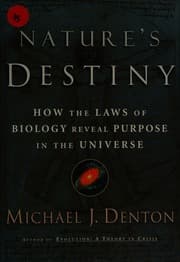
Nature's Destiny: How the Laws of Biology Reveal Purpose in the Universe
مصير الطبيعة: كيف تكشف قوانين علم الأحياء الهدف في الكون
Le Destin de la Nature : Comment les Lois de la Biologie Révèlent un Dessein dans l'Univers
Editorial summary
Michael Denton's Nature's Destiny presents a comprehensive argument for cosmic teleology grounded in the fine-tuning of natural laws for biological life. Building upon the anthropic principle, Denton extends the discussion beyond physics to examine how the fundamental properties of matter, the periodic table, and the characteristics of water, carbon, and other elements appear precisely calibrated not merely for life's existence, but for its evolution toward complexity and intelligence.
Denton, a molecular biologist, employs a multidisciplinary approach that synthesizes findings from biochemistry, physics, astronomy, and evolutionary biology. His central thesis challenges both materialistic neo-Darwinism and traditional creationism by proposing what he terms "directed evolution" - the view that while evolution proceeds through natural mechanisms, these mechanisms themselves reflect an underlying cosmic purpose. He argues that the universe's bio-friendly nature extends far beyond what coincidence could explain, encompassing everything from the properties of water that enable protein folding to the specific characteristics of carbon chemistry that permit DNA's information storage.
The work systematically examines numerous examples of apparent fine-tuning in biology: the unique properties of water including its anomalous expansion when freezing, the peculiar fitness of carbon for forming complex molecules, the specific wavelengths of light optimal for photosynthesis and vision, and the precise values of fundamental constants that permit stable atoms and chemistry. Denton argues these features collectively point toward nature being "prefabricated" for life's emergence and development.
Positioned against both Richard Dawkins's blind watchmaker thesis and young-earth creationism, Denton's argument represents a sophisticated form of natural theology updated for the molecular age. He explicitly rejects supernatural intervention while maintaining that naturalistic processes themselves embody purpose. This stance places him in dialogue with other design theorists like Paul Davies and Freeman Dyson, though Denton's biological focus distinguishes his contribution.
The work's significance lies in its detailed biological argumentation for cosmic purpose, moving beyond physics-based fine-tuning arguments. By grounding teleology in empirical biological observations rather than philosophical speculation, Denton challenges the prevailing scientific orthodoxy that purpose represents merely anthropomorphic projection. His argument that life's fundamental requirements are satisfied with suspicious precision throughout nature's hierarchy - from subatomic to cosmic scales - provides substantial material for contemporary debates about design, chance, and necessity in nature's constitution.
Argument formulations engaged
Denton, Michael (1998). Nature's Destiny: How the Laws of Biology Reveal Purpose in the Universe.
@book{natures-destiny-how-the-laws-of-biology-,
  author    = {Denton, Michael},
  title     = {Nature's Destiny: How the Laws of Biology Reveal Purpose in the Universe},
  year      = {1998},
  url       = {https://god-database.com/en/works/natures-destiny-how-the-laws-of-biology-reveal-purpose-in-the-universe-1998}
}