
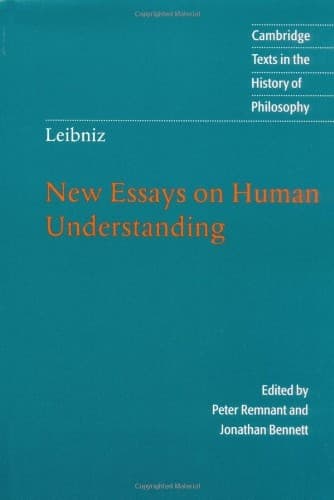
New Essays on Human Understanding
مقالات جديدة حول الفهم الإنساني
Nouveaux Essais sur l'Entendement Humain
Editorial summary
Leibniz's New Essays on Human Understanding, composed between 1703 and 1705 but published posthumously in 1765, constitutes a systematic response to John Locke's Essay Concerning Human Understanding. This philosophical dialogue examines fundamental questions about innate ideas, knowledge acquisition, and the nature of divine understanding, thereby making significant contributions to early modern debates about God's existence and attributes.
The work adopts a unique dialogical format in which Philalethes represents Locke's empiricist position while Theophilus articulates Leibniz's rationalist alternative. Through this conversational structure, Leibniz challenges Locke's rejection of innate ideas by arguing that the human mind possesses inherent principles, including the idea of God. Against empiricist claims that all knowledge derives from sensory experience, Leibniz contends that certain truths, particularly those concerning necessary beings and eternal verities, exist within the soul prior to experience.
Central to Leibniz's theological argument is his defense of the ontological proof for God's existence, which Locke had dismissed as merely verbal. Leibniz maintains that the idea of a supremely perfect being necessarily entails existence, provided such a being is possible. He grounds this possibility in his theory of compossibility and the principle of sufficient reason, arguing that God's existence explains why anything exists rather than nothing. The work further develops Leibniz's conception of God as the source of both existences and essences, whose understanding encompasses all possible worlds.
The New Essays significantly advances discussions about divine attributes through its treatment of infinity, necessity, and perfection. Leibniz argues that human minds, as finite expressions of the divine intellect, possess an innate capacity to recognize necessary truths that reflect God's eternal understanding. This position challenges both empiricist epistemology and voluntarist theology, proposing instead that reason itself participates in divine rationality.
The text's influence extends beyond its immediate context, shaping subsequent debates about natural theology, the relationship between faith and reason, and the epistemological foundations of religious belief. By defending innate ideas and rational theology against empiricist critique, Leibniz's work establishes important precedents for later German idealism and continues to inform contemporary discussions about religious epistemology and the cognitive basis of theistic belief.
Argument formulations engaged
Related works
Leibniz, G. W. (1765). New Essays on Human Understanding.
@book{new-essays-on-human-understanding-1765,
  author    = {Leibniz, G. W.},
  title     = {New Essays on Human Understanding},
  year      = {1765},
  url       = {https://god-database.com/en/works/new-essays-on-human-understanding-1765}
}