
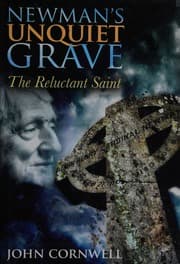
Newman's Unquiet Grave: The Reluctant Saint
قبر نيومان القلق: القديس المتردد
La Tombe Inquiète de Newman : Le Saint Réticent
Editorial summary
This biographical study examines John Henry Newman's complex intellectual and spiritual journey, particularly his conversion from Anglicanism to Roman Catholicism and his subsequent theological contributions to debates about faith, reason, and religious authority. Cornwell presents Newman as a figure whose life and thought illuminate fundamental tensions in modern religious belief, making him particularly relevant to contemporary discussions about God's existence and the nature of religious knowledge.
The work traces Newman's development from his evangelical Anglican origins through his leadership of the Oxford Movement to his eventual Catholic conversion in 1845. Cornwell emphasizes how Newman's intellectual struggles embodied broader nineteenth-century conflicts between traditional religious belief and emerging modern skepticism. The biography particularly focuses on Newman's attempt to articulate a middle path between fideism and rationalism, developing a sophisticated epistemology of religious belief that acknowledged both the role of reason and the necessity of what he termed the "illative sense" in arriving at religious conviction.
Central to Cornwell's analysis is Newman's Grammar of Assent, which the biographer presents as a crucial contribution to philosophical theology. This work challenged both the narrow evidentialism of religious skeptics and the anti-intellectual tendencies within Christianity itself. Cornwell demonstrates how Newman argued that belief in God emerges not from formal logical proofs alone but from a convergence of probabilities apprehended by the whole person. This approach anticipated later developments in reformed epistemology and continues to influence contemporary philosophy of religion.
The biography also examines Newman's critique of liberalism in religion, which he saw as evacuating Christianity of its supernatural content while maintaining its cultural forms. Cornwell shows how Newman's analysis of religious liberalism remains pertinent to current debates about secularization and the possibility of maintaining robust theistic belief in modernity. The work explores tensions between Newman's philosophical sophistication and his submission to ecclesiastical authority, presenting these not as contradictions but as expressions of his complex understanding of faith's relationship to reason.
Cornwell's study contributes to the God debate by recovering Newman as a thinker who refused simple dichotomies between faith and reason, authority and conscience, tradition and development. The biography demonstrates how Newman's thought offers resources for those seeking intellectually credible forms of theistic belief while acknowledging the genuine challenges posed by modern critical thought.
Argument formulations engaged
Cornwell, John (2010). Newman's Unquiet Grave: The Reluctant Saint.
@book{newmans-unquiet-grave-the-reluctant-sain,
  author    = {Cornwell, John},
  title     = {Newman's Unquiet Grave: The Reluctant Saint},
  year      = {2010},
  url       = {https://god-database.com/en/works/newmans-unquiet-grave-the-reluctant-saint-2010}
}