
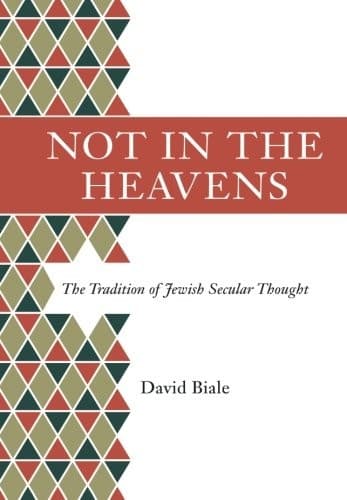
Not in the Heavens: The Tradition of Jewish Secular Thought
ليس في السماوات: تقليد الفكر العلماني اليهودي
Pas dans les Cieux : La Tradition de la Pensée Juive Séculière
Editorial summary
David Biale's monograph presents a comprehensive historical analysis of Jewish secular thought, challenging conventional assumptions about the inherent religiosity of Jewish culture. The work traces a complex intellectual tradition from Spinoza through contemporary thinkers, demonstrating how Jewish secularism emerged not simply as a rejection of religion but as a distinctive mode of Jewish cultural expression that reimagined traditional concepts in non-theological terms.
Biale argues that Jewish secularism constitutes a coherent intellectual tradition with its own internal logic and development. Rather than viewing secularization as mere assimilation or abandonment of Jewish identity, he contends that secular Jewish thinkers creatively transformed religious concepts into new frameworks for understanding Jewish existence. The study examines how figures like Spinoza, Heine, Freud, Einstein, and Hannah Arendt engaged with Jewish texts and traditions while rejecting traditional theological premises, producing alternative visions of Jewish meaning grounded in ethics, culture, nationalism, or universal human values.
The work's methodology combines intellectual history with cultural analysis, situating individual thinkers within broader movements of European modernization while highlighting specifically Jewish dimensions of their secular philosophies. Biale demonstrates how Jewish secularists often maintained complex relationships with religious tradition, simultaneously drawing upon and subverting biblical and rabbinic sources. His analysis reveals how concepts like chosenness, exile, and messianism underwent radical reinterpretation in secular contexts, becoming vehicles for political liberation, cultural renewal, or ethical universalism rather than divine providence.
Significantly for debates about God and religion, Biale's study complicates simplistic dichotomies between belief and unbelief. He shows how Jewish secularism often involved not straightforward atheism but rather various forms of religious transformation, where theological language persisted even as supernatural referents disappeared. The work engages critically with theories of secularization that posit inevitable religious decline, instead presenting Jewish secularism as a creative cultural force that generated new forms of Jewish expression.
The monograph contributes to understanding how religious traditions adapt to modernity through internal critique and transformation rather than simple abandonment. Biale's nuanced treatment reveals secularism not as religion's opposite but as one possible outcome of religious tradition's encounter with modern thought, suggesting that the boundaries between religious and secular worldviews remain more porous and productive than often acknowledged in contemporary debates about belief and unbelief.
Argument formulations engaged
Biale, David (2011). Not in the Heavens: The Tradition of Jewish Secular Thought.
@book{not-in-the-heavens-the-tradition-of-jewi,
  author    = {Biale, David},
  title     = {Not in the Heavens: The Tradition of Jewish Secular Thought},
  year      = {2011},
  url       = {https://god-database.com/en/works/not-in-the-heavens-the-tradition-of-jewish-secular-thought-2011}
}