
Objections and Replies
اعتراضات وردود
Objections et Réponses
Editorial summary
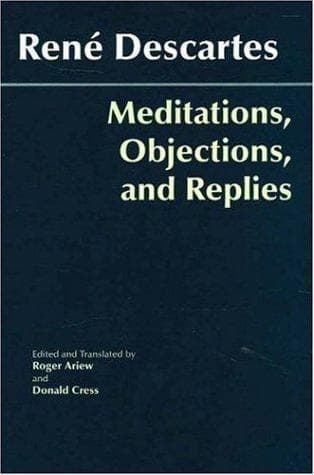
The Objections and Replies constitute the second half of Descartes' 1641 publication of the Meditations on First Philosophy, representing one of early modern philosophy's most significant dialogical engagements with the question of God's existence. This collection features critiques from leading theologians and philosophers of the period, including Antoine Arnauld, Pierre Gassendi, and Thomas Hobbes, alongside Descartes' detailed responses to their challenges.
The work centers on defending two primary arguments for God's existence presented in the Meditations. The first, appearing in the Third Meditation, argues from the idea of God as infinite perfection to God's necessary existence as the cause of this idea. The second, found in the Fifth Meditation, presents an ontological argument claiming that existence belongs to God's essence just as mathematical properties belong to geometric figures. The objectors scrutinize these proofs from multiple angles, questioning whether the idea of infinity truly requires an infinite cause, whether existence can be treated as a perfection, and whether Descartes' arguments avoid circularity.
Descartes employs a methodical approach in his replies, clarifying distinctions between formal and objective reality, explaining the difference between contingent and necessary existence, and defending his use of clear and distinct perception as a criterion of truth. His responses reveal important elaborations not fully developed in the Meditations themselves, particularly regarding the relationship between divine veracity and human knowledge, and the nature of substance and attributes.
The intellectual context reflects the tension between scholastic Aristotelian philosophy and emerging mechanistic worldviews. Several objectors worry that Descartes' arguments undermine traditional theological proofs, while others suggest his radical doubt threatens religious certainty. Gassendi's empiricist criticisms and Hobbes' materialist challenges preview later philosophical developments, while Arnauld's theological concerns highlight the delicate balance Descartes seeks between philosophical innovation and religious orthodoxy.
This work's significance lies in demonstrating how Descartes' theistic arguments withstand sophisticated philosophical scrutiny while revealing their points of vulnerability. The exchanges illuminate fundamental issues about causation, perfection, and existence that continue to shape debates about God. The dialogical format provides invaluable insight into how contemporary thinkers received and challenged new approaches to natural theology, making it essential reading for understanding the transformation of God-discourse in early modern philosophy.
Argument formulations engaged
Related works
Descartes, Rene (1641). Objections and Replies.
@book{objections-and-replies-1641,
  author    = {Descartes, Rene},
  title     = {Objections and Replies},
  year      = {1641},
  url       = {https://god-database.com/en/works/objections-and-replies-1641}
}