
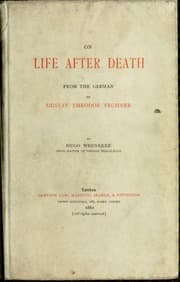
On Life After Death
عن الحياة بعد الموت
Sur la Vie Après la Mort
Editorial summary
Fechner's On Life After Death presents a philosophical argument for human immortality grounded in a distinctive metaphysical framework that challenges prevailing materialist assumptions of early nineteenth-century German thought. Writing against the mechanistic worldview that dominated scientific discourse in his era, Fechner develops a sophisticated defense of personal survival after death through an appeal to analogical reasoning and what he terms the "law of stability."
The work's central argument proceeds from Fechner's panpsychist conviction that consciousness pervades all of nature in varying degrees of complexity. He contends that human death represents not an annihilation of consciousness but rather a transition to a higher form of mental existence. Just as the caterpillar's apparent death yields the butterfly, Fechner argues that bodily death enables consciousness to transcend its physical limitations and enter into a more expansive mode of being. This transformation, he maintains, follows necessarily from the fundamental indestructibility of mental substance and the progressive character of cosmic evolution.
Fechner's method combines speculative philosophy with appeals to empirical observation, particularly drawing on botanical and entomological examples to support his analogical arguments. He explicitly positions his work against both crude materialism, which reduces consciousness to mere epiphenomena of physical processes, and traditional religious dogmatism, which relies solely on scriptural authority. Instead, Fechner seeks a middle path that honors both scientific reasoning and spiritual intuition.
The treatise's significance lies in its attempt to reconcile scientific naturalism with religious hopes for immortality without recourse to traditional theological categories. Fechner's influence extends beyond philosophy of religion to the development of experimental psychology and process thought. His argument that consciousness exists on a continuum throughout nature anticipates later developments in panpsychist philosophy, while his emphasis on experiential continuity after death offers a naturalistic alternative to dualistic conceptions of the soul.
The work represents an important contribution to nineteenth-century debates about personal identity, the mind-body problem, and the possibility of empirically grounded spiritual philosophy. Fechner's vision of death as transformation rather than termination provides a framework for understanding immortality that avoids both reductive materialism and naive supernaturalism, establishing him as a significant figure in the philosophical reconciliation of science and religion.
Argument formulations engaged
Related works
Fechner, Gustav (1836). On Life After Death.
@book{on-life-after-death-1836,
  author    = {Fechner, Gustav},
  title     = {On Life After Death},
  year      = {1836},
  url       = {https://god-database.com/en/works/on-life-after-death-1836}
}