
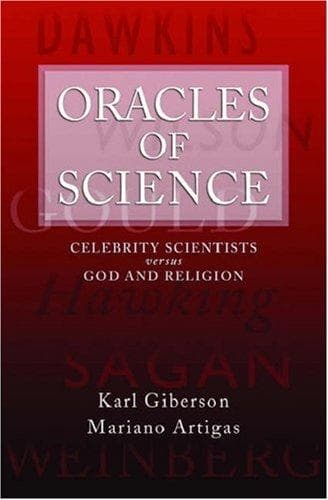
Oracles of Science.. Celebrity Scientists versus God and Religion
أوراكل العلم.. العلماء المشهورون في مواجهة الله والدين
Les oracles de la science.. Les scientifiques célèbres face à Dieu et à la religion
The pronouncements of celebrity scientists on God and religion carry less philosophical authority than their public prestige suggests, and a critical examination of their arguments reveals significant overreach beyond scientific competence.
Editorial summary
Karl Giberson's Oracles of Science: Celebrity Scientists versus God and Religion examines the complex relationship between prominent scientific figures and religious belief in contemporary public discourse. The monograph investigates how certain scientists have achieved celebrity status and subsequently wielded their cultural authority to pronounce on matters of theology and metaphysics, often beyond their formal expertise. Giberson analyzes the rhetorical strategies and philosophical assumptions underlying these interventions in the God debate, paying particular attention to how scientific celebrity translates into perceived authority on ultimate questions.
Through an intellectual-historical approach, Giberson traces the emergence of what he terms "oracles of science" - figures like Richard Dawkins, Stephen Jay Gould, Carl Sagan, Stephen Hawking, Steven Weinberg, and Edward O. Wilson - who have shaped public understanding of the relationship between science and religion. The work demonstrates how these scientists' popular writings and public statements have constructed particular narratives about the compatibility or incompatibility of scientific knowledge with religious belief. Giberson examines both the content of their arguments and the cultural mechanisms through which scientific expertise becomes transformed into broader philosophical authority.
The monograph engages substantially with design arguments and fine-tuning arguments, analyzing how celebrity scientists have responded to these traditional theistic proofs. Giberson explores how figures like Dawkins critique biological design arguments through evolutionary theory, while physicists like Weinberg and Hawking address cosmological fine-tuning through multiverse theories or anthropic principles. The work reveals how these scientific responses often embed philosophical presuppositions that extend beyond empirical science proper.
Giberson's analysis contributes to the God debate by illuminating the sociological dimensions of science-religion discourse. Rather than simply adjudicating between theistic and atheistic positions, the work exposes how cultural authority, media representation, and public rhetoric shape these debates. The monograph demonstrates that the conflict narrative between science and religion is partly constructed through the public personas and rhetorical choices of celebrity scientists. By historicizing these interventions and examining their philosophical underpinnings, Giberson provides tools for more nuanced engagement with scientific challenges to religious belief. The work ultimately suggests that the perceived conflict between science and religion owes as much to cultural dynamics and individual personalities as to substantive intellectual disagreements.
Structured analysis
Structure of the work
Argument formulations engaged
Related works
Giberson, Karl (2007). Oracles of Science.. Celebrity Scientists versus God and Religion. Oxford University Press.
@book{oracles-of-science-celebrity-scientists-,
  author    = {Giberson, Karl},
  title     = {Oracles of Science.. Celebrity Scientists versus God and Religion},
  year      = {2007},
  publisher = {Oxford University Press},
  url       = {https://god-database.com/en/works/oracles-of-science-celebrity-scientists-versus-god-and-religion}
}