
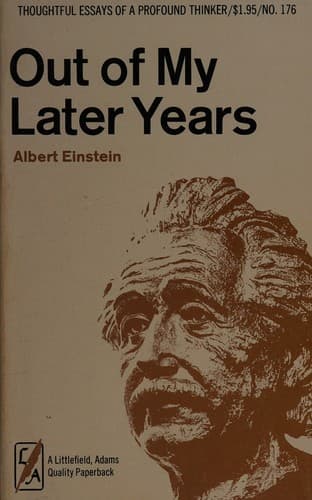
Out of My Later Years
من سنواتي المتأخرة
Mes dernières années
Editorial summary
Einstein's "Out of My Later Years" presents the mature reflections of the twentieth century's most celebrated physicist on science, society, and metaphysical questions. This collection of essays, written during Einstein's Princeton years, reveals how his scientific worldview shaped his understanding of religious and philosophical matters. Rather than offering systematic theological arguments, Einstein articulates a distinctive position that resists conventional categorization within traditional debates about God's existence.
The work develops what Einstein terms "cosmic religious feeling," a profound sense of awe before the rational order of the universe. This perspective emerges from his scientific practice, where the discovery of mathematical laws governing nature evokes what he describes as religious emotion, yet one entirely divorced from anthropomorphic conceptions of deity. Einstein explicitly rejects personal theism, arguing that the idea of a God who intervenes in human affairs or judges moral behavior represents a primitive stage of religious development. Instead, he advocates for a religion compatible with scientific rationality, one that finds the sacred in the comprehensible structure of reality itself.
Throughout these essays, Einstein engages critically with traditional religious institutions while maintaining that genuine religiosity and science share common ground in their pursuit of truth and their reverence for the mysterious. He positions himself against both dogmatic materialism and conventional theism, suggesting that the cosmic religious feeling represents a higher form of religious experience precisely because it dispenses with doctrine and mythology. This stance places him in tension with both religious orthodoxy and reductive scientism.
The philosophical significance of Einstein's position lies in its attempt to preserve religious sensibility within a thoroughly naturalistic framework. His concept of cosmic religion influenced subsequent discussions about the relationship between science and spirituality, particularly among scientists seeking to articulate non-reductive forms of naturalism. The work contributes to debates about whether religious experience requires belief in supernatural entities or whether it might be grounded in scientific wonder.
Einstein's method combines autobiographical reflection with philosophical argumentation, drawing on his scientific work to illuminate broader metaphysical questions. His writing demonstrates how scientific practice itself can generate what he considers authentic religious feeling, while maintaining strict adherence to empirical method and logical reasoning. This approach offers a distinctive voice in discussions about the compatibility of scientific and religious worldviews.
Argument formulations engaged
Einstein, Albert (1950). Out of My Later Years.
@book{out-of-my-later-years-1950,
  author    = {Einstein, Albert},
  title     = {Out of My Later Years},
  year      = {1950},
  url       = {https://god-database.com/en/works/out-of-my-later-years-1950}
}