
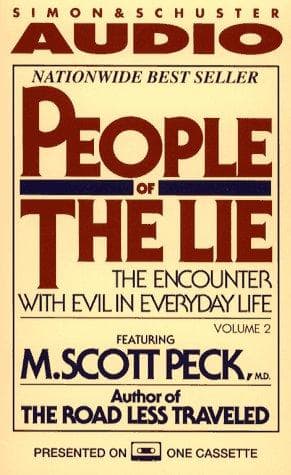
People of the Lie: The Hope for Healing Human Evil
أشخاص من الكذب: الأمل في شفاء الشر البشري
Les gens du mensonge : L'espoir de guérir le mal humain
Editorial summary
M. Scott Peck's "People of the Lie: The Hope for Healing Human Evil" extends his psychiatric framework from "The Road Less Traveled" into a controversial exploration of human evil, proposing that evil constitutes a diagnosable form of mental illness requiring both psychological and spiritual treatment. Writing as a practicing psychiatrist who underwent a Christian conversion, Peck attempts to bridge clinical psychology with theological categories, arguing that modern psychiatry's reluctance to engage with evil as a distinct phenomenon represents a dangerous blind spot in understanding human destructiveness.
The work advances a clinical definition of evil as militant ignorance—a persistent refusal to acknowledge one's own capacity for harm, coupled with active projection of this shadow onto others. Through detailed case studies from his psychiatric practice, Peck identifies patterns among individuals he classifies as evil: narcissistic self-image preservation at any cost, consistent scapegoating of others, intellectual deviousness, and an inability to think from another's perspective. Unlike sociopathy, which involves absent conscience, Peck's "evil" patients possess moral awareness but systematically suppress it through elaborate self-deception.
Central to Peck's argument is his conviction that evil represents a spiritual disorder requiring religious resources for healing. He explicitly grounds his analysis in Christian theology while maintaining psychiatric methodology, creating a hybrid approach that challenges both secular psychology and traditional religious thought. The work engages critically with prevailing psychiatric orthodoxy that reduces destructive behavior to trauma, brain chemistry, or social conditioning, insisting instead on the reality of human choice and spiritual rebellion.
Peck's integration of demonic possession as a rare but real phenomenon marks the work's most contentious claim. He describes his participation in exorcisms and argues for their legitimacy within carefully controlled therapeutic contexts, distinguishing genuine possession from psychosis through specific diagnostic criteria. This positions the text against both materialist psychiatry and sensationalist religious approaches to evil.
The monograph's significance lies in its attempt to restore evil as a category for psychological investigation while maintaining scientific rigor. Peck challenges the modern tendency to explain away human destructiveness through deterministic models, advocating instead for an approach that takes seriously both human freedom and the possibility of chosen malevolence. His work reopens questions about the relationship between psychology and theology, suggesting that effective treatment of certain forms of human destructiveness requires acknowledgment of their fundamentally spiritual character.
Argument formulations engaged
Related works
Peck, Scott (1983). People of the Lie: The Hope for Healing Human Evil.
@book{people-of-the-lie-the-hope-for-healing-h,
  author    = {Peck, Scott},
  title     = {People of the Lie: The Hope for Healing Human Evil},
  year      = {1983},
  url       = {https://god-database.com/en/works/people-of-the-lie-the-hope-for-healing-human-evil-1983}
}