
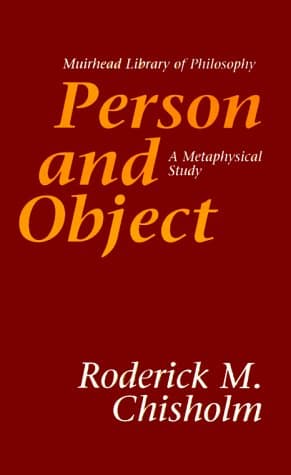
Person and Object
الشخص والموضوع
Personne et objet
Editorial summary
Chisholm's Person and Object develops a systematic metaphysical framework that has significant implications for philosophical theology, particularly regarding the nature of persons and their relationship to God. The work presents a comprehensive ontology grounded in mereological essentialism and a substantive theory of personal identity that challenges both materialist and process philosophical accounts of personhood.
Central to Chisholm's argument is his defense of substance dualism and the persistence of personal identity through time. He maintains that persons are essentially immaterial substances distinct from their bodies, a position that aligns with traditional theistic conceptions of the soul. His mereological essentialism—the view that objects have their parts essentially—provides a rigorous framework for understanding both finite persons and, by extension, divine personhood. Chisholm argues that persons possess a special ontological status as "entia per se" (beings in themselves) rather than mere constructions or bundles of properties.
The work engages critically with Humean skepticism about the self and contemporary physicalist theories of mind. Against Hume's bundle theory, Chisholm defends the reality of substantial selves as primitive, unanalyzable entities. His arguments against materialism employ modal considerations about the conceivability of disembodied existence, which have direct bearing on questions of immortality and divine immateriality. The book's treatment of intentionality and first-person reference provides tools for understanding religious experience and divine-human communication.
Chisholm's method combines careful conceptual analysis with attention to ordinary language and common-sense intuitions about personhood. He draws on the scholastic tradition, particularly Aquinas and Suarez, while engaging contemporary analytic philosophy. His defense of agent causation offers resources for understanding divine action and human free will in ways compatible with traditional theism.
The work's significance for the God debate lies in its sophisticated defense of metaphysical commitments often presumed by theistic philosophy: the reality of immaterial substances, the irreducibility of persons to physical processes, and the possibility of disembodied existence. While Chisholm does not explicitly argue for God's existence, his metaphysical framework provides conceptual foundations that support classical theistic claims about divine personhood, human souls, and post-mortem survival. His rigorous analytical approach demonstrates that such traditional metaphysical views can be defended within contemporary philosophical discourse without abandoning intellectual respectability.
Argument formulations engaged
Chisholm, Roderick (1976). Person and Object. Open Court Publishing Company.
@book{person-and-object-1976,
  author    = {Chisholm, Roderick},
  title     = {Person and Object},
  year      = {1976},
  publisher = {Open Court Publishing Company},
  url       = {https://god-database.com/en/works/person-and-object-1976}
}