
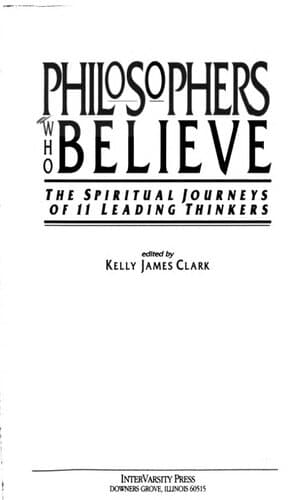
Philosophers Who Believe: The Spiritual Journeys of 11 Leading Thinkers
فلاسفة يؤمنون: الرحلات الروحية لـ11 مفكراً رائداً
Philosophes qui croient : Les parcours spirituels de 11 penseurs majeurs
Editorial summary
This edited volume presents personal testimonies from eleven prominent Christian philosophers, offering intimate accounts of how religious faith shapes their intellectual work. Clark assembles contributions from leading figures including Alvin Plantinga, Richard Swinburne, Frederick Suppe, and others who detail their spiritual journeys and explain how Christian belief informs their philosophical practice. The collection serves as both a response to prevailing secular assumptions in academic philosophy and a demonstration that rigorous philosophical inquiry can coexist with, and even emerge from, deep religious conviction.
The work's primary contribution lies in challenging the widespread presumption that professional philosophy necessarily leads to religious skepticism or atheism. By featuring philosophers who have maintained or developed Christian faith while pursuing careers at elite institutions, the volume counters narratives that portray religious belief as intellectually unsophisticated or incompatible with serious philosophical work. Each contributor addresses the relationship between faith and reason from their personal experience, discussing how they navigate potential tensions and find mutual enrichment between religious commitment and philosophical inquiry.
The philosophers employ various approaches to reconcile their Christianity with their academic work. Some contributors describe how philosophical training deepened their faith by providing tools to articulate and defend religious beliefs more precisely. Others explain how their faith commitments motivate particular philosophical projects or shape their approach to perennial questions in metaphysics, epistemology, and ethics. Several essays address specific philosophical challenges to theism, demonstrating how these thinkers engage skeptical arguments while maintaining their religious convictions.
Clark's editorial framing positions these testimonies within broader debates about the rationality of religious belief and the sociology of academic philosophy. The volume implicitly argues against both crude fideism and reductive naturalism, presenting instead a model of thoughtful integration between faith and philosophical reflection. By focusing on personal narratives rather than formal arguments, the collection offers a unique window into how religious belief functions in the lives of professional philosophers.
The significance of this work extends beyond its apologetic value. It documents an important moment in late twentieth-century philosophy when Christian philosophers began asserting their presence more confidently in mainstream academic discourse. The volume thus serves both as a sociological artifact and as a substantive contribution to discussions about the relationship between religious faith and philosophical practice.
Argument formulations engaged
Clark, Kelly James (1993). Philosophers Who Believe: The Spiritual Journeys of 11 Leading Thinkers. InterVarsity Press.
@book{philosophers-who-believe-the-spiritual-j,
  author    = {Clark, Kelly James},
  title     = {Philosophers Who Believe: The Spiritual Journeys of 11 Leading Thinkers},
  year      = {1993},
  publisher = {InterVarsity Press},
  url       = {https://god-database.com/en/works/philosophers-who-believe-the-spiritual-journeys-of-11-leading-thinkers-1993}
}