
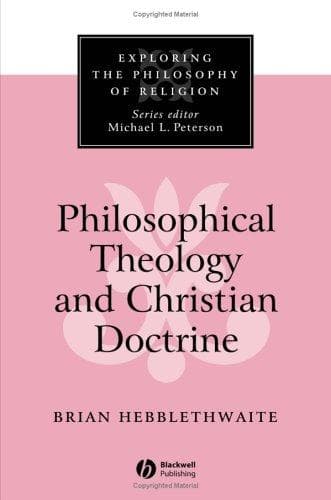
Philosophical Theology
اللاهوت الفلسفي
Théologie philosophique
Editorial summary
This monograph presents a systematic defense of philosophical theology as a legitimate intellectual enterprise that bridges philosophy and Christian doctrine. Hebblethwaite constructs his argument against two primary adversaries: secular philosophers who dismiss theological reasoning as intellectually bankrupt, and fideistic theologians who reject philosophical analysis as irrelevant or hostile to faith. The work demonstrates how philosophical methods can illuminate theological concepts without reducing them to purely rational constructs.
The author employs an integrative methodology that draws from both analytic philosophy and the Christian theological tradition. Rather than treating philosophy and theology as separate domains, Hebblethwaite argues for their mutual enrichment. He examines classical philosophical problems—the nature of existence, causation, personhood, and temporality—through a theological lens while simultaneously subjecting theological doctrines to philosophical scrutiny. This approach allows him to address perennial questions about divine attributes, the problem of evil, religious language, and the rationality of religious belief.
Central to Hebblethwaite's project is his defense of natural theology's continued relevance in contemporary thought. He contends that reason can provide genuine, if limited, knowledge of God's existence and nature, positioning himself against both Barthian revelationalism and logical positivism. The work engages critically with major figures in twentieth-century philosophy of religion, including Alvin Plantinga, Richard Swinburne, and John Hick, while also drawing on historical sources from Aquinas to Kant.
The monograph's significance lies in its balanced articulation of how philosophical analysis serves theological understanding without compromising either discipline's integrity. Hebblethwaite demonstrates that philosophical theology need not choose between rational autonomy and faithful submission but can maintain creative tension between them. His treatment of specific doctrines—particularly the Trinity, Incarnation, and divine action—shows how philosophical precision can clarify rather than dissolve theological mysteries.
The work contributes to the God debate by establishing philosophical theology's intellectual credentials while acknowledging its inherent limitations. Hebblethwaite's position represents a middle way between crude rationalism and anti-intellectual fideism, arguing that belief in God can be both philosophically sophisticated and authentically religious. His defense of theism operates not through knockdown arguments but through cumulative case-building that respects both philosophical rigor and theological depth.
Argument formulations engaged
Related works
Hebblethwaite, Brian (1993). Philosophical Theology. Wiley.
@book{philosophical-theology-1993,
  author    = {Hebblethwaite, Brian},
  title     = {Philosophical Theology},
  year      = {1993},
  publisher = {Wiley},
  url       = {https://god-database.com/en/works/philosophical-theology-1993}
}