
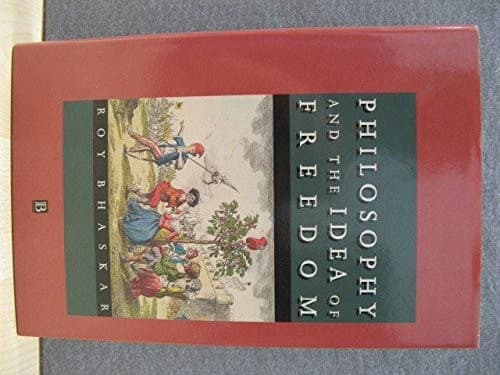
Philosophy and the Idea of Freedom
الفلسفة وفكرة الحرية
Philosophie et l'idée de liberté
Editorial summary
This monograph presents a systematic philosophical defense of critical realism as a framework for understanding human freedom and emancipation. Bhaskar develops his argument through a sustained critique of contemporary philosophical traditions, particularly empiricism and idealism, which he contends fail to provide adequate foundations for understanding either natural or social reality. The work extends his earlier contributions to the philosophy of science into the domain of social theory and human agency.
Central to Bhaskar's argument is the notion of ontological stratification - the idea that reality consists of multiple levels or domains that cannot be reduced to one another. He distinguishes between the empirical (experiences), the actual (events), and the real (underlying structures and mechanisms), arguing that philosophical traditions that collapse these distinctions inevitably produce impoverished accounts of both knowledge and freedom. This stratified ontology becomes crucial for his understanding of human agency, which he locates within complex webs of social structures that both enable and constrain action.
The work engages critically with major figures in twentieth-century philosophy, including Wittgenstein, Winch, Rorty, and Habermas. Bhaskar argues that linguistic philosophy's focus on language games and forms of life fails to account for the material conditions that shape human possibilities. Similarly, he critiques postmodern relativism for undermining the very possibility of rational critique and emancipatory politics. Against these positions, he defends a notion of judgmental rationality that acknowledges fallibility while maintaining the possibility of distinguishing between more and less adequate theories.
While not explicitly addressing theological questions, the monograph has significant implications for the God debate. Bhaskar's critical realism challenges both naive materialism and idealist accounts of reality, opening conceptual space for discussing transcendent realities without abandoning scientific rationality. His emphasis on emergence and irreducibility suggests ways of conceiving divine action that avoid both interventionist supernaturalism and reductive naturalism. Moreover, his account of human freedom as requiring both agential powers and enabling structures provides resources for thinking about divine-human interaction in non-competitive terms. The work's influence extends beyond philosophy to theology, where critical realism has become an important framework for scholars seeking to move beyond sterile oppositions between science and religion.
Argument formulations engaged
Bhaskar, Roy (1991). Philosophy and the Idea of Freedom. Routledge.
@book{philosophy-and-the-idea-of-freedom-1991,
  author    = {Bhaskar, Roy},
  title     = {Philosophy and the Idea of Freedom},
  year      = {1991},
  publisher = {Routledge},
  url       = {https://god-database.com/en/works/philosophy-and-the-idea-of-freedom-1991}
}