
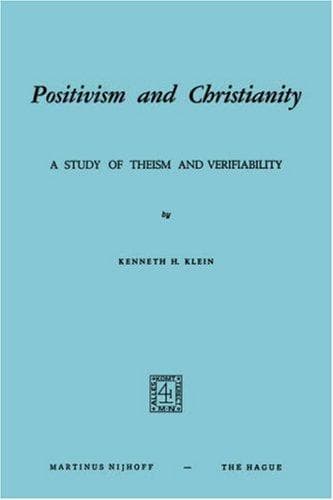
Positivism and Christianity.. A Study of Theism and Verifiability
الوضعية والمسيحية..دراسة في الإيمان بالإله والقابلية للتحقق
Positivisme et christianisme..Une étude du théisme et de la vérifiabilité
Theistic claims can be meaningfully assessed within a verificationist framework, and positivist challenges to religious language do not decisively undermine the rational defensibility of Christian theism.
Editorial summary
This monograph examines the complex relationship between logical positivism's verification principle and Christian theism, offering a nuanced analysis of how verificationist criteria apply to religious claims. Klein investigates whether theistic statements can satisfy positivist standards of meaningfulness while maintaining their essential religious character.
The work addresses a central tension in twentieth-century philosophy of religion: the positivist challenge that religious statements lack cognitive content because they cannot be empirically verified. Klein explores various strategies Christian philosophers have employed to respond to this challenge, including attempts to reformulate theological claims in verifiable terms, arguments that religious language operates according to different logical rules, and critiques of the verification principle itself. His analysis engages with key figures in both positivist thought and Christian philosophical responses, examining how different interpretations of verifiability yield different assessments of theistic discourse.
Klein's methodology combines conceptual analysis with historical investigation, tracing the development of verificationist thought and its application to religious language. He examines the cumulative case for theism not as a single decisive argument but as a collection of considerations that together support religious belief's rationality. The work considers how various forms of evidence—experiential, historical, and philosophical—might contribute to a verifiable foundation for theistic claims without reducing religion to purely empirical assertions.
The monograph's significance lies in its systematic treatment of a foundational debate in analytic philosophy of religion. Rather than simply defending theism against positivist critique or capitulating to verificationist demands, Klein maps the conceptual territory between these positions. He demonstrates how the verification debate illuminates deeper questions about the nature of religious knowledge, the scope of meaningful discourse, and the relationship between empirical evidence and metaphysical claims.
Klein's analysis proves particularly valuable for understanding how Christian analytic philosophy developed its distinctive approach to defending theism's cognitive credentials. By examining both the strengths and limitations of verificationist critiques, the work contributes to ongoing discussions about religious epistemology and the standards by which theological claims should be evaluated. His treatment reveals how the positivism-theism encounter shaped subsequent developments in philosophy of religion, particularly regarding the nature of religious evidence and the logic of cumulative case arguments.
Structured analysis
Structure of the work
Argument formulations engaged
Klein, Kenneth H. (1974). Positivism and Christianity.. A Study of Theism and Verifiability.
@book{positivism-and-christianity-a-study-of-t,
  author    = {Klein, Kenneth H.},
  title     = {Positivism and Christianity.. A Study of Theism and Verifiability},
  year      = {1974},
  url       = {https://god-database.com/en/works/positivism-and-christianity-a-study-of-theism-and-verifiability}
}