
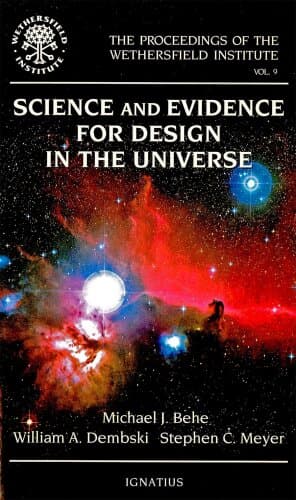
Proceedings.. Science and Evidence for Design in the Universe
وقائع.. العلم والأدلة على التصميم في الكون
Actes.. La science et les preuves du dessein dans l'univers
Scientific evidence from biology, cosmology, and information theory converges to support the inference that the universe and living systems bear the hallmarks of intelligent design.
Editorial summary
Michael Behe's contribution to the 1999 proceedings "Science and Evidence for Design in the Universe" advances a sophisticated argument for intelligent design through the lens of molecular biology and philosophy of science. The work represents a significant intervention in the late 20th-century debate over design arguments, offering what Behe considers empirical grounds for inferring design in biological systems while engaging critically with naturalistic explanations of complexity.
Central to Behe's argument is the concept of "irreducible complexity," which he defines as biological systems composed of multiple interacting parts where removal of any single component renders the system non-functional. Drawing from molecular biology, Behe examines specific biochemical systems—such as the bacterial flagellum, blood clotting cascade, and cellular transport mechanisms—arguing that their intricate interdependence resists explanation through gradual Darwinian processes. His philosophy of science methodology emphasizes empirical observation while challenging the explanatory adequacy of neo-Darwinian theory at the molecular level.
The work engages directly with evolutionary biologists and philosophers who maintain that natural selection sufficiently accounts for biological complexity. Behe critiques what he perceives as the unfalsifiable nature of certain evolutionary explanations, arguing that appeals to unknown intermediate forms or unspecified selective advantages fail to meet rigorous scientific standards. He positions intelligent design as a legitimate scientific inference, analogous to how archaeologists identify designed artifacts or how forensic scientists detect intentional causation.
Significantly, Behe's argument intersects with fine-tuning discussions by suggesting that the existence of irreducibly complex systems points toward purposive arrangement rather than chance or necessity. While avoiding explicit theological commitments, he maintains that design inference follows naturally from empirical observation of biological systems. His approach attempts to bridge scientific investigation with broader metaphysical questions about purpose and intentionality in nature.
The work's importance lies in its attempt to ground design arguments in specific biochemical examples rather than general appeals to complexity or beauty. By focusing on molecular mechanisms unknown to earlier design theorists, Behe seeks to demonstrate that advances in biological science strengthen rather than weaken the case for design. This contribution sparked intense debate about the boundaries of scientific explanation and the legitimacy of design inference in biological contexts, making it a pivotal text in contemporary discussions of science, philosophy, and the question of God.
Structured analysis
Argument formulations engaged
Related works
Behe, Michael J. (1999). Proceedings.. Science and Evidence for Design in the Universe. Ignatius Press.
@book{proceedings-science-and-evidence-for-des,
  author    = {Behe, Michael J.},
  title     = {Proceedings.. Science and Evidence for Design in the Universe},
  year      = {1999},
  publisher = {Ignatius Press},
  url       = {https://god-database.com/en/works/proceedings-science-and-evidence-for-design-in-the-universe}
}