
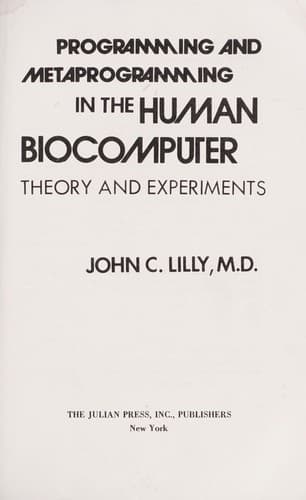
Programming and Metaprogramming in the Human Biocomputer
البرمجة والبرمجة الفوقية في الحاسوب الحيوي البشري
Programmation et métaprogrammation dans le bioordinateur humain
Editorial summary
John Cunningham Lilly's "Programming and Metaprogramming in the Human Biocomputer" presents consciousness as a biological information processing system analogous to a computer, offering a naturalistic framework that implicitly challenges traditional theological conceptions of mind, soul, and divine consciousness. Drawing from his experiments with sensory deprivation tanks and psychedelics, Lilly develops a cybernetic model of human consciousness that reduces mental phenomena, including religious experiences, to programmable neurological processes.
Lilly's central thesis posits that the human brain operates as a "biocomputer" running various programs and metaprograms that determine perception, belief, and behavior. This computational metaphor extends to spiritual experiences, which Lilly interprets not as encounters with transcendent reality but as products of altered neural programming. His methodology combines empirical observation from isolation tank experiments with theoretical frameworks from computer science and neurophysiology, creating a reductionist account of consciousness that leaves no explanatory room for supernatural causation.
The work's significance to debates about God lies in its systematic naturalization of mystical experiences. Where religious traditions interpret profound altered states as divine encounters or spiritual revelations, Lilly's biocomputer model explains them as reprogramming events within a closed biological system. His detailed phenomenology of consciousness alteration, including experiences often described as union with the divine or cosmic consciousness, receives purely mechanistic explanation through concepts of neural circuits, feedback loops, and information processing.
Particularly relevant is Lilly's treatment of belief systems themselves as programs within the biocomputer. Religious faith, in this framework, becomes not a response to divine reality but a self-reinforcing program that shapes perception and interpretation of experience. This perspective anticipates later cognitive science approaches to religion while extending the materialist critique of religious consciousness beyond traditional philosophical arguments.
The monograph's influence extends through both scientific and countercultural circles, contributing to naturalistic theories of consciousness that challenge dualist and theological accounts of mind. By providing a detailed model for understanding extraordinary experiences without recourse to supernatural explanation, Lilly's work represents a significant contribution to materialist philosophy of mind. His biocomputer metaphor, while dated in its specific computational analogies, establishes a research program for understanding religious and mystical experiences as natural phenomena subject to scientific investigation rather than theological interpretation.
Argument formulations engaged
Lilly, John Cunningham (1972). Programming and Metaprogramming in the Human Biocomputer. The Julian Press.
@book{programming-and-metaprogramming-in-the-h,
  author    = {Lilly, John Cunningham},
  title     = {Programming and Metaprogramming in the Human Biocomputer},
  year      = {1972},
  publisher = {The Julian Press},
  url       = {https://god-database.com/en/works/programming-and-metaprogramming-in-the-human-biocomputer-1972}
}