
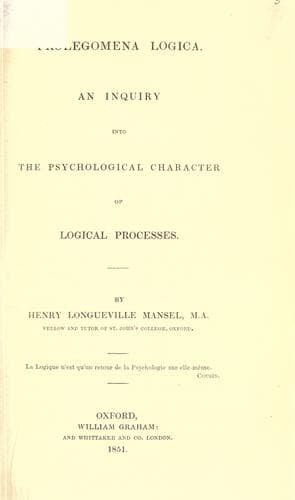
Prolegomena Logica
مقدمات منطقية
Prolégomènes logiques
Editorial summary
This work presents a systematic examination of the fundamental principles of logic, with particular attention to their implications for religious knowledge and the limits of human understanding. Mansel constructs a comprehensive framework for logical analysis that ultimately serves his broader philosophical project of defending religious faith against rationalist critiques while simultaneously establishing boundaries for legitimate theological speculation.
The text develops a sophisticated account of the laws of thought, beginning with detailed analysis of concepts, judgments, and reasoning processes. Mansel draws extensively on Kantian epistemology while incorporating insights from British empiricism, particularly the work of Hamilton. His treatment emphasizes the conditioned nature of human knowledge, arguing that all thinking operates within inherent limitations that prevent absolute comprehension of the infinite or unconditioned. This epistemological framework becomes crucial for his approach to religious questions, as it establishes principled grounds for both affirming theistic belief and restricting speculative theology.
Central to Mansel's argument is his critique of rationalist attempts to construct positive knowledge of divine attributes through pure reason. He contends that logic itself, properly understood, demonstrates the impossibility of such endeavors. The human mind, operating through the categories of finite experience, cannot adequately conceive or represent the infinite nature of God. This limitation, however, does not lead Mansel to skepticism but rather to a defense of revealed religion. He argues that recognition of reason's boundaries creates legitimate space for faith based on revelation, which provides knowledge inaccessible to purely logical analysis.
The work engages critically with contemporary German idealism, particularly Hegel's system, which Mansel views as transgressing the proper limits of human reason in its attempt to achieve absolute knowledge. His logical investigations thus serve a dual purpose: establishing rigorous foundations for valid reasoning while demonstrating why certain metaphysical ambitions must fail. This approach influences subsequent debates about the relationship between logic and theology, particularly in Anglican philosophical theology.
Mansel's contribution lies in his sophisticated attempt to use logical analysis itself to establish both the legitimacy and limits of religious knowledge. By grounding his defense of faith in rigorous examination of reason's own structure, he provides a distinctive response to both rationalist theology and religious skepticism, arguing that proper understanding of logic supports a moderate position that affirms theistic belief while rejecting speculative excess.
Argument formulations engaged
Related works
Mansel, Henry Longueville (1860). Prolegomena Logica.
@book{prolegomena-logica-1860,
  author    = {Mansel, Henry Longueville},
  title     = {Prolegomena Logica},
  year      = {1860},
  url       = {https://god-database.com/en/works/prolegomena-logica-1860}
}