
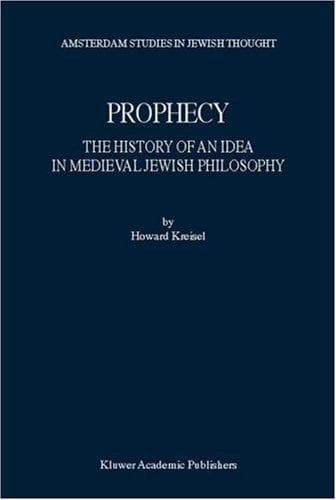
Prophecy.. The History of an Idea in Medieval Jewish Philosophy
النبوة.. تاريخ فكرة في الفلسفة اليهودية الوسيطة
La Prophétie.. Histoire d'une idée dans la philosophie juive médiévale
The concept of prophecy in medieval Jewish philosophy underwent a sustained and complex evolution, shaped by the interplay of biblical tradition, Neoplatonic emanationism, and Aristotelian rationalism across a succession of major thinkers.
Editorial summary
This monograph presents a comprehensive intellectual history of prophecy as understood within medieval Jewish philosophy, tracing the evolution of this central theological concept from its biblical and rabbinic foundations through its sophisticated philosophical reformulations. Kreisel examines how Jewish thinkers from the tenth through fifteenth centuries grappled with fundamental questions about the nature of prophetic experience, its epistemological status, and its relationship to both human perfection and divine providence.
The work demonstrates how medieval Jewish philosophers increasingly moved away from supernatural explanations of prophecy toward naturalistic accounts grounded in Aristotelian psychology and metaphysics. Beginning with Saadia Gaon's relatively traditional approach, Kreisel traces the gradual philosophization of prophecy through figures like Isaac Israeli, Judah Halevi, Abraham ibn Daud, and culminating in the radical naturalism of Maimonides and his successors. He shows how Maimonides revolutionized Jewish thought by presenting prophecy as the natural result of intellectual and imaginative perfection, achievable through philosophical contemplation rather than divine election alone.
Kreisel's analysis reveals the tensions this philosophical approach created with traditional religious authority. If prophecy represents a natural human capacity tied to intellectual development, what distinguishes Moses from philosophers? How can prophetic law maintain its binding character if prophecy itself operates through natural channels? The study explores how thinkers like Gersonides pushed naturalistic explanations even further while others, including Crescas and Albo, attempted to preserve elements of divine voluntarism within philosophical frameworks.
The monograph situates these developments within broader intellectual currents, showing how Jewish philosophers engaged with Islamic predecessors like Al-Farabi and Avicenna while responding to specifically Jewish theological concerns. Kreisel demonstrates that debates about prophecy served as a crucial arena for negotiating the relationship between revelation and reason, tradition and philosophy.
This work contributes significantly to understanding how medieval Jewish thinkers reconceptualized divine-human communication within philosophical frameworks. By mapping the diverse approaches to prophecy across centuries of Jewish thought, Kreisel illuminates fundamental questions about religious epistemology, the nature of revelation, and the possibility of human knowledge of God. His intellectual history reveals prophecy as a pivotal concept through which medieval Jewish philosophers articulated their understanding of how finite human beings might access divine truth.
Structured analysis
Structure of the work
Argument formulations engaged
Kreisel, Howard (2001). Prophecy.. The History of an Idea in Medieval Jewish Philosophy. Springer Science+Business Media.
@book{prophecy-the-history-of-an-idea-in-medie,
  author    = {Kreisel, Howard},
  title     = {Prophecy.. The History of an Idea in Medieval Jewish Philosophy},
  year      = {2001},
  publisher = {Springer Science+Business Media},
  url       = {https://god-database.com/en/works/prophecy-the-history-of-an-idea-in-medieval-jewish-philosophy}
}