
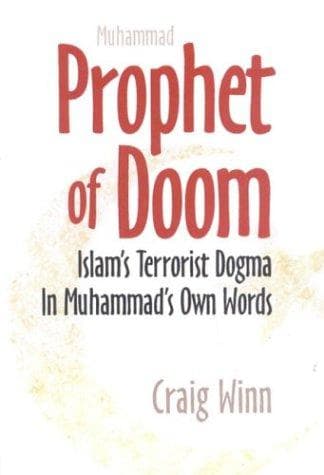
Prophet of Doom.. Islam's Terrorist Dogma in Muhammad's Own Words
نبي الهلاك.. العقيدة الإرهابية للإسلام بكلمات محمد الخاصة
Prophète de malheur.. Le dogme terroriste de l'islam dans les propres paroles de Muhammad
Islam's foundational texts, read in Muhammad's own words, reveal a doctrine that is inherently violent and incompatible with modern civilization.
Editorial summary
Craig Winn's Prophet of Doom represents a provocative attempt to demonstrate Islam's inherently violent nature through analysis of primary Islamic sources. The work examines the Qur'an, Hadith literature, and early Islamic histories to argue that terrorism and violence constitute essential rather than aberrant elements of Islamic doctrine, tracing these characteristics directly to Muhammad's teachings and actions.
Winn employs a methodologically straightforward approach, compiling and analyzing passages from Islamic texts that describe or prescribe violence, particularly focusing on Muhammad's military campaigns, treatment of opponents, and theological justifications for warfare. The author structures his argument chronologically, following Muhammad's life while highlighting instances of violence, deception, and what he characterizes as moral failings. His textual analysis emphasizes literal readings of sources, rejecting allegorical or contextual interpretations favored by many Islamic scholars.
The work engages critically with the prophecy argument by challenging Muhammad's prophetic claims through examination of Qur'anic verses and biographical materials. Winn argues that Muhammad's prophecies were either unfulfilled, borrowed from existing traditions, or retroactively composed. He presents Muhammad not as a divine messenger but as a calculating political leader who manufactured religious justifications for personal ambitions. This critique extends to questioning the Qur'an's divine origins, suggesting instead that it reflects Muhammad's evolving political needs and psychological states.
Written in the post-9/11 context, the monograph participates in broader debates about Islam's compatibility with modernity and peaceful coexistence. Winn positions his work against what he perceives as apologetic scholarship that minimizes or recontextualizes violent passages in Islamic texts. He explicitly challenges both Muslim theologians who argue for peaceful interpretations of Islam and Western academics who attribute Islamic extremism to political rather than theological causes.
The significance of Winn's contribution lies less in its scholarly rigor—the work lacks engagement with critical scholarship on early Islam and relies heavily on selective quotation—than in its representation of a particular strand of post-9/11 critique of Islam. The monograph exemplifies how textual analysis can be employed polemically, using religious sources to construct arguments about the essential nature of religious traditions. While academically marginal, such works influence public discourse about Islam and raise questions about methodological standards in religious criticism.
Structured analysis
Structure of the work
Argument formulations engaged
Winn, Craig (2004). Prophet of Doom.. Islam's Terrorist Dogma in Muhammad's Own Words.
@book{prophet-of-doom-islams-terrorist-dogma-i,
  author    = {Winn, Craig},
  title     = {Prophet of Doom.. Islam's Terrorist Dogma in Muhammad's Own Words},
  year      = {2004},
  url       = {https://god-database.com/en/works/prophet-of-doom-islams-terrorist-dogma-in-muhammads-own-words}
}