
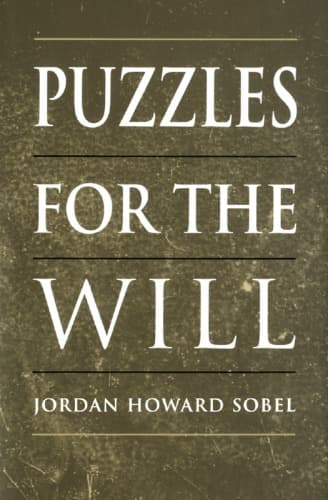
Puzzles for the Will
ألغاز للإرادة
Énigmes pour la volonté
Editorial summary
This volume assembles Jordan Howard Sobel's sophisticated contributions to philosophical debates about divine foreknowledge, human freedom, and theological determinism. Sobel engages these classical puzzles through rigorous logical analysis, examining how various conceptions of God's omniscience relate to questions of human agency and moral responsibility. The work represents a significant intervention in analytic philosophy of religion, particularly in clarifying the logical structure of traditional theological paradoxes.
The monograph addresses several interconnected problems that arise when divine attributes meet human action. Sobel examines the compatibility of God's perfect foreknowledge with genuine human freedom, analyzing whether divine omniscience necessarily entails fatalism. He investigates various proposed solutions, including theories of middle knowledge, temporal indexing of divine knowledge, and distinctions between different modes of necessity. His approach combines formal logic with careful attention to historical theological positions, particularly engaging with medieval scholastic debates while employing contemporary analytical tools.
A central contribution involves Sobel's analysis of the consequence argument and its theological applications. He demonstrates how standard arguments about determinism and free will become more complex when divine foreknowledge enters the equation. The work carefully distinguishes between logical fatalism, causal determinism, and theological necessitarianism, showing how each generates distinct challenges for reconciling human freedom with divine omniscience. Sobel examines whether God's knowledge of future contingents differs fundamentally from knowledge of past events or necessary truths.
The text engages critically with major figures in contemporary philosophy of religion, including Alvin Plantinga's free will defense, William Hasker's open theism, and Linda Zagzebski's work on divine foreknowledge. Sobel identifies logical difficulties in various reconciliation strategies, demonstrating how attempts to preserve both libertarian free will and classical theism often generate new paradoxes. His analysis reveals tensions between different divine attributes when combined with robust conceptions of human agency.
Sobel's work matters because it clarifies the logical geography of these enduring theological puzzles without premature closure. Rather than defending a particular theological position, he maps the conceptual terrain with exceptional precision, showing exactly where the pressure points lie in reconciling traditional theistic commitments with intuitions about human freedom. This careful analytical work provides essential groundwork for subsequent debates about divine attributes, human agency, and the coherence of classical theism.
Argument formulations engaged
Sobel, Jordan Howard (1998). Puzzles for the Will. University of Toronto Press.
@book{puzzles-for-the-will-1998,
  author    = {Sobel, Jordan Howard},
  title     = {Puzzles for the Will},
  year      = {1998},
  publisher = {University of Toronto Press},
  url       = {https://god-database.com/en/works/puzzles-for-the-will-1998}
}