
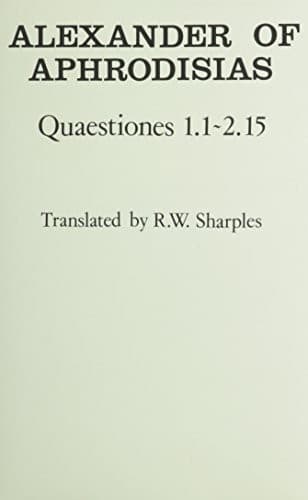
Quaestiones
مسائل
Editorial summary
Alexander of Aphrodisias's Quaestiones represents one of the most significant philosophical investigations of divine nature and causation from the early third century CE. As the leading Aristotelian commentator of his era, Alexander develops a sophisticated account of God as the unmoved mover while engaging critically with Stoic, Platonic, and emerging Christian conceptions of divinity. The collection demonstrates how ancient philosophical theology could proceed through rigorous conceptual analysis rather than religious revelation or mystical speculation.
The work's central contribution lies in its systematic defense of Aristotelian theology against competing schools. Alexander argues that God exists as pure actuality and thought thinking itself, serving as the final cause of all cosmic motion without direct providential involvement in particular events. This position challenges Stoic pantheism, which identifies God with the material cosmos, and Platonic emanationism, which posits intermediary divine principles. Alexander maintains that divine perfection requires complete separation from material reality, making God the object of the heavens' desire rather than an efficient cause acting upon the world.
Alexander's method combines textual exegesis of Aristotle with independent philosophical argumentation. He addresses apparent tensions in Aristotelian theology, particularly regarding how an unmoved mover can serve as an object of desire for non-rational celestial bodies. His solution involves attributing a form of natural appetite to the heavenly spheres, allowing them to imitate divine perfection through eternal circular motion. This move preserves divine transcendence while explaining cosmic order without recourse to anthropomorphic providence.
The Quaestiones proves especially significant for demonstrating the viability of philosophical monotheism independent of revealed religion. Writing in Alexandria during Christianity's expansion, Alexander shows how reason alone can establish God's existence and essential attributes. His arguments influenced both Islamic philosophers like al-Farabi and Christian scholastics like Aquinas, who adapted Aristotelian natural theology for their own purposes. The work also contains important discussions of divine knowledge, addressing whether God knows particulars or only universals, with Alexander defending a restrictive view that preserves divine immutability.
Through careful analysis of causation, motion, and perfection, Alexander constructs a philosophically rigorous account of divinity that avoids both materialist reduction and mystical obscurantism. His Quaestiones remains essential for understanding how ancient philosophy approached fundamental questions about God's existence, nature, and relationship to the cosmos through rational inquiry.
Argument formulations engaged
Aphrodisias, Alexander of (200). Quaestiones.
@book{quaestiones-200,
  author    = {Aphrodisias, Alexander of},
  title     = {Quaestiones},
  year      = {200},
  url       = {https://god-database.com/en/works/quaestiones-200}
}