
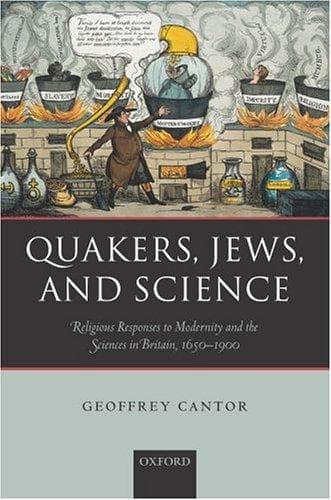
Quakers, Jews, and Science.. Religious Responses to Modernity and the Sciences in Britain, 1650-1900
الكويكرز واليهود والعلم.. الاستجابات الدينية للحداثة والعلوم في بريطانيا، 1650-1900
Quakers, Juifs et science.. Réponses religieuses à la modernité et aux sciences en Grande-Bretagne, 1650-1900
The religious responses of Quakers and Jews to modern science in Britain between 1650 and 1900 reveal distinct communal strategies for negotiating the relationship between faith and natural knowledge.
Editorial summary
Geoffrey Cantor's monograph examines how two religious minorities in Britain, Quakers and Jews, engaged with modern science between 1650 and 1900, offering significant insights into the relationship between religious belief and scientific practice. Rather than perpetuating simplistic narratives of conflict or harmony between religion and science, Cantor demonstrates how these communities negotiated complex relationships with scientific knowledge while maintaining their distinctive religious identities.
The work employs intellectual history methodology to trace how Quakers and Jews participated in scientific endeavors while adapting to modernity's challenges. Cantor shows that both groups, despite their marginalization from mainstream British society and exclusion from universities until the nineteenth century, produced notable scientific practitioners and developed sophisticated theological responses to scientific developments. His analysis reveals how religious commitments shaped scientific interests and interpretations without necessarily impeding scientific work.
For Quakers, Cantor demonstrates how their emphasis on inner light and direct divine revelation influenced their approach to natural philosophy. Many Quakers pursued sciences like botany and astronomy, viewing nature study as complementary to spiritual insight. The author traces how Quaker scientists reconciled their peace testimony with participation in scientific institutions sometimes connected to military applications, and how their religious epistemology shaped their scientific methodology.
Regarding Jews, Cantor explores how Jewish engagement with science intensified as emancipation progressed. He analyzes how Jewish thinkers addressed challenges posed by geology, evolution, and biblical criticism while maintaining religious commitments. The work illuminates how some Jewish scientists saw their scientific work as fulfilling religious obligations to understand creation, while others compartmentalized religious and scientific domains.
Cantor's contribution to discussions about God and science lies in his nuanced portrayal of lived religious-scientific practice. Against both the conflict thesis and facile harmonization attempts, he presents religious communities actively negotiating between traditional beliefs and modern knowledge. His work demonstrates that religious responses to science were neither monolithic nor predetermined by doctrine but emerged through complex historical processes involving social position, communal values, and individual choices. By focusing on marginalized groups, Cantor enriches understanding of how religious belief systems adapt to scientific change while maintaining theological integrity, contributing valuable historical perspective to contemporary debates about religion's compatibility with scientific worldviews.
Structured analysis
Structure of the work
Argument formulations engaged
Cantor, Geoffrey (2005). Quakers, Jews, and Science.. Religious Responses to Modernity and the Sciences in Britain, 1650-1900.
@book{quakers-jews-and-science-religious-respo,
  author    = {Cantor, Geoffrey},
  title     = {Quakers, Jews, and Science.. Religious Responses to Modernity and the Sciences in Britain, 1650-1900},
  year      = {2005},
  url       = {https://god-database.com/en/works/quakers-jews-and-science-religious-responses-to-modernity-and-the-sciences-in-britain-1650-1900}
}