
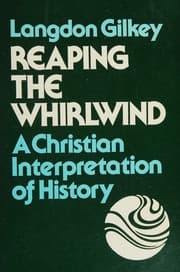
Reaping the Whirlwind: A Christian Interpretation of History
حصاد العاصفة: تفسير مسيحي للتاريخ
Récolter la tempête : Une interprétation chrétienne de l'histoire
Editorial summary
This ambitious work presents a theological interpretation of historical process that synthesizes Christian eschatology with critical analysis of contemporary secular historiographies. Gilkey argues that meaningful historical interpretation requires theological categories, specifically the Christian understanding of divine providence and eschatological hope, while simultaneously engaging seriously with Marxist, liberal progressive, and existentialist philosophies of history.
The monograph develops through systematic critique of prevailing secular interpretations of history, demonstrating what Gilkey perceives as their internal contradictions and ultimate inability to provide adequate meaning to historical experience. Against positivist historiography that reduces history to mere factual chronicle, and against both optimistic progressivism and nihilistic interpretations that emerge from purely immanent frameworks, Gilkey proposes a distinctively Christian hermeneutic. This approach maintains divine sovereignty over historical process while preserving human freedom and responsibility, interpreting contemporary crises as manifestations of judgment that nonetheless contain possibilities for redemption.
Central to Gilkey's argument is the concept of providence understood not as deterministic divine control but as God's creative and redemptive presence within ambiguous historical developments. He employs the biblical metaphor of "reaping the whirlwind" to characterize how human sin generates historical consequences that serve simultaneously as judgment and potential occasions for grace. This theological framework enables interpretation of catastrophic events, particularly twentieth-century totalitarianism and warfare, without reducing them either to divine punishment or meaningless suffering.
The work's significance lies in its sophisticated attempt to construct a viable Christian philosophy of history for the modern period. Writing in the aftermath of Vietnam and amid Cold War tensions, Gilkey addresses the challenge of maintaining religious interpretation of history after the collapse of simple progressive narratives. His method combines biblical theology, particularly prophetic literature, with philosophical analysis drawn from Tillich, Niebuhr, and process thought.
Gilkey's contribution to the God debate centers on demonstrating how theistic commitment shapes historical interpretation and ethical response. Against secular philosophies that either absolutize or evacuate historical meaning, he argues that Christian theology provides unique resources for understanding history as meaningful yet open, judged yet redeemable. The work thus presents not merely theoretical argument for God's existence but practical demonstration of how theistic belief functions as interpretive framework for human temporal experience.
Argument formulations engaged
Gilkey, Langdon (1976). Reaping the Whirlwind: A Christian Interpretation of History.
@book{reaping-the-whirlwind-a-christian-interp,
  author    = {Gilkey, Langdon},
  title     = {Reaping the Whirlwind: A Christian Interpretation of History},
  year      = {1976},
  url       = {https://god-database.com/en/works/reaping-the-whirlwind-a-christian-interpretation-of-history-1976}
}