
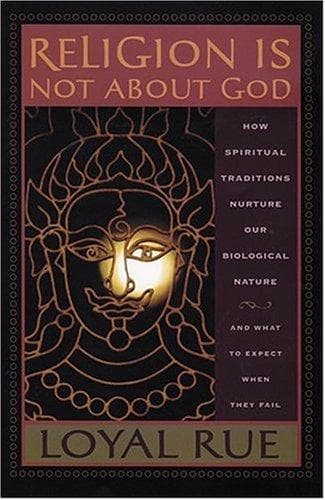
Religion Is Not about God
الدين ليس عن الإله
La Religion ne parle pas de Dieu
Loyal Rue argues that religion is fundamentally not about God but about human nature, serving as a culturally evolved system that aligns personal wholeness with social coherence through narrative and symbol.
Editorial summary
Loyal Rue's provocative monograph advances a thoroughly naturalistic account of religion that deliberately sidesteps metaphysical questions about divine existence. The work's central thesis contends that religious systems function primarily as adaptive strategies for human survival, having evolved to promote social cohesion and individual wellbeing rather than to establish truths about supernatural realities. Rue employs evolutionary biology and cognitive science to argue that religions persist not because they accurately describe ultimate reality, but because they effectively organize human communities and provide existential orientation.
The analysis proceeds through three interconnected arguments. First, Rue demonstrates how religious narratives and rituals serve crucial biosocial functions by encoding behavioral norms, establishing group boundaries, and motivating altruistic cooperation. Second, he traces the evolutionary advantages conferred by religious belief systems, showing how groups with strong religious frameworks historically outcompeted those without such organizing principles. Third, he explores the cognitive mechanisms underlying religious experience, suggesting that humans possess evolved tendencies toward pattern recognition, agency detection, and meaning-making that naturally generate religious interpretations of existence.
Rue's naturalistic-evolutionary methodology directly challenges both traditional theological approaches and militant atheistic critiques. Against theologians who ground religion in divine revelation or rational proofs, he argues that religious phenomena require no supernatural explanation. Against atheists who dismiss religion as mere delusion, he demonstrates its profound adaptive significance. His work engages extensively with sociological theories of religion, particularly those of Durkheim and Wilson, while incorporating recent findings from evolutionary psychology and neuroscience.
The monograph's significance lies in reframing fundamental questions about religion's nature and value. By arguing that religion's truth-value matters less than its life-value, Rue opens space for appreciating religious traditions without accepting their metaphysical claims. This position proves particularly relevant for contemporary debates about religion's role in secular societies. His framework suggests that dismissing religion as obsolete ignores its deep evolutionary roots and ongoing social functions.
Critics challenge Rue's reductionism and his apparent conflation of religion's origins with its validity. Nevertheless, his work represents a sophisticated attempt to naturalize religious phenomena while acknowledging their profound human significance. The monograph contributes substantially to naturalistic explanations of religion, offering a nuanced alternative to both theological apologetics and simplistic debunking.
Structured analysis
Argument formulations engaged
Rue, Loyal Religion Is Not about God. Rutgers University Press.
@book{religion-is-not-about-god,
  author    = {Rue, Loyal},
  title     = {Religion Is Not about God},
  year      = {n.d.},
  publisher = {Rutgers University Press},
  url       = {https://god-database.com/en/works/religion-is-not-about-god}
}