
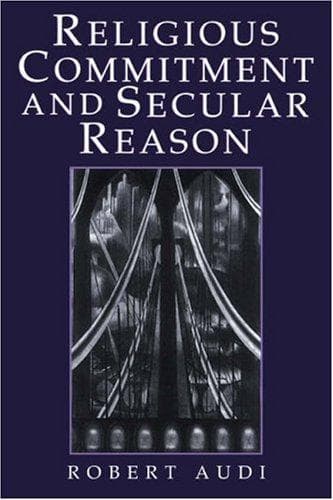
Religious Commitment and Secular Reason
الالتزام الديني والعقل العلماني
Engagement religieux et raison séculière
Editorial summary
In Religious Commitment and Secular Reason, Robert Audi develops a comprehensive framework for understanding how religious believers should engage in public discourse within liberal democratic societies. The work addresses a central tension in contemporary philosophy of religion and political theory: how can citizens with deep religious commitments participate in public deliberation while respecting the pluralistic nature of modern democracies?
Audi advances a nuanced position that seeks middle ground between strict secularism and religious fundamentalism. He argues that religious citizens can and should bring their faith-based perspectives into public discourse, but must do so in ways that respect what he terms the "ethics of citizenship." This involves articulating reasons that fellow citizens who do not share their religious premises can nonetheless understand and potentially accept. The work introduces important distinctions between religious reasons and secular reasons, arguing that while the former may motivate political positions, the latter should typically accompany them in public justification.
Central to Audi's argument is his principle of secular rationale, which holds that citizens have a prima facie obligation to provide adequate secular reasons for coercive laws and public policies. This does not exclude religious reasoning from public life but requires that it be supplemented by accessible secular arguments. He carefully distinguishes this from the stronger principle of secular motivation, which he ultimately rejects as too demanding. Religious believers may be motivated entirely by their faith commitments, provided they can articulate secular grounds for their political positions.
The work engages critically with John Rawls's conception of public reason, offering both refinements and challenges. While sympathetic to Rawlsian concerns about stability and legitimacy in pluralistic societies, Audi argues for a more accommodating approach to religious discourse. He also responds to critics from both secular and religious perspectives, addressing concerns that his position either marginalizes faith or inadequately protects secular governance.
Audi's contribution lies in providing a sophisticated theoretical framework that takes seriously both religious commitment and democratic values. His work offers practical guidance for religious citizens navigating political engagement while contributing to broader debates about the proper relationship between religion and politics. The monograph remains influential in discussions about public reason, religious freedom, and the challenges of political discourse in diverse societies.
Argument formulations engaged
Related works
Audi, Robert (2000). Religious Commitment and Secular Reason. Cambridge University Press.
@book{religious-commitment-and-secular-reason-,
  author    = {Audi, Robert},
  title     = {Religious Commitment and Secular Reason},
  year      = {2000},
  publisher = {Cambridge University Press},
  url       = {https://god-database.com/en/works/religious-commitment-and-secular-reason-2000}
}