
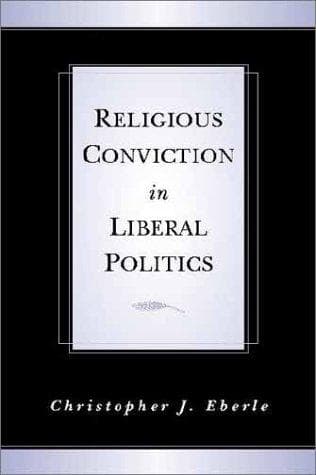
Religious Conviction in Liberal Politics
الإيمان الديني في السياسة الليبرالية
Conviction religieuse en politique libérale
Editorial summary
Christopher Eberle's Religious Conviction in Liberal Politics challenges the dominant liberal position that citizens should refrain from supporting coercive laws based solely on religious convictions. This work enters a contentious debate within political philosophy about the proper role of religious reasons in public justification, particularly addressing the constraints that theorists like John Rawls and Robert Audi place on religious citizens in democratic deliberation.
Eberle develops what he terms an "ideal of conscientious engagement," arguing against the standard liberal requirement of restraint. His central thesis maintains that religious citizens may legitimately support coercive policies based on religious convictions alone, provided they sincerely attempt to find secular justifications that their fellow citizens might accept. This position mediates between unrestricted religious advocacy and the exclusion of religious reasons from political discourse. The work systematically examines and rejects various formulations of the restraint doctrine, including Rawls's public reason requirement and Audi's principle of secular rationale.
The argument proceeds through careful philosophical analysis of liberal commitments to respect for persons and democratic legitimacy. Eberle contends that requiring religious citizens to bracket their deepest convictions when voting or advocating for laws constitutes a form of disrespect incompatible with liberal values. He examines real-world cases, particularly debates over military service and education policy, to demonstrate how his ideal of conscientious engagement would function in practice. The work engages extensively with contemporary political liberalism, responding to critics who argue that religious reasons threaten democratic stability or violate principles of reciprocity.
This monograph significantly impacts debates about God and religious conviction in political life by defending a more inclusive role for theistic reasoning in democratic societies. While not arguing for God's existence directly, Eberle's work presupposes the legitimacy and rationality of religious belief, treating theistic convictions as potentially valid bases for political action. His position challenges secular liberal theorists who seek to minimize religion's public influence, while also critiquing religious authoritarians who would impose sectarian views without regard for public justification. The work's sophisticated treatment of conscience, coercion, and democratic dialogue establishes it as essential reading for understanding how theistic commitments might properly function within pluralistic democracies. Its influence extends beyond philosophy to legal theory and religious studies, reshaping discussions about the relationship between religious conviction and political legitimacy.
Argument formulations engaged
Eberle, Christopher (2002). Religious Conviction in Liberal Politics. Cambridge University Press.
@book{religious-conviction-in-liberal-politics,
  author    = {Eberle, Christopher},
  title     = {Religious Conviction in Liberal Politics},
  year      = {2002},
  publisher = {Cambridge University Press},
  url       = {https://god-database.com/en/works/religious-conviction-in-liberal-politics-2002}
}