
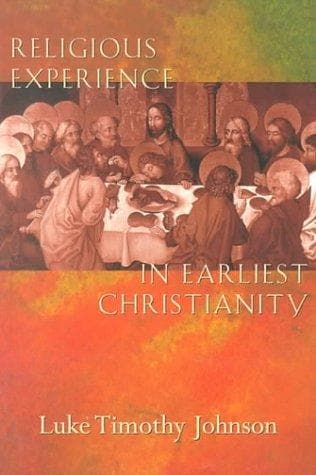
Religious Experience in Earliest Christianity
التجربة الدينية في المسيحية المبكرة
Expérience religieuse dans le christianisme primitif
Editorial summary
Johnson's Religious Experience in Earliest Christianity represents a significant intervention in New Testament scholarship by arguing that religious experience constitutes the primary generative force behind early Christian texts and communities. Against the prevailing historical-critical approaches that prioritize textual reconstruction and social-historical context, Johnson contends that scholars have systematically neglected the experiential dimensions of early Christianity, particularly encounters with divine power that shaped both individual and communal identity.
The work develops its argument through careful analysis of New Testament texts, demonstrating how experiences of the Holy Spirit, visions, healings, and prophetic utterances function not as peripheral phenomena but as central organizing principles of early Christian life. Johnson critiques reductionist approaches that explain away religious experiences as merely psychological or sociological phenomena, insisting instead that these experiences possessed genuine transformative power for their recipients and demanded serious scholarly attention as religious phenomena in their own right.
Methodologically, Johnson employs a phenomenological approach that takes seriously the first-person accounts and communal testimonies preserved in early Christian literature. He examines how experiences of divine presence generated new patterns of worship, ethical transformation, and missionary expansion. The work particularly emphasizes glossolalia, prophetic speech, and healing miracles as concrete manifestations of divine power that validated early Christian claims about God's active presence in the world through Jesus Christ.
The monograph's contribution to debates about God lies in its insistence that early Christianity emerged not from abstract theological speculation but from concrete experiences interpreted as divine encounters. Johnson argues that these experiences provided epistemic warrant for early Christian truth claims about God's character and activity. His analysis suggests that religious experience offers a distinct mode of knowing that complements but cannot be reduced to rational discourse or historical investigation.
While not directly arguing for God's existence, Johnson's work challenges naturalistic assumptions in biblical scholarship by treating religious experiences as irreducible data requiring explanation. His approach reopens questions about divine action in history that much contemporary scholarship had foreclosed. The work thus provides resources for understanding how experiential claims about God functioned in early Christianity while maintaining scholarly rigor in examining these claims. Johnson's emphasis on experience as a valid category of analysis has influenced subsequent discussions about the relationship between religious phenomena and academic study of religion.
Argument formulations engaged
Johnson, Luke Timothy (1998). Religious Experience in Earliest Christianity. Fortress Press.
@book{religious-experience-in-earliest-christi,
  author    = {Johnson, Luke Timothy},
  title     = {Religious Experience in Earliest Christianity},
  year      = {1998},
  publisher = {Fortress Press},
  url       = {https://god-database.com/en/works/religious-experience-in-earliest-christianity-1998}
}