
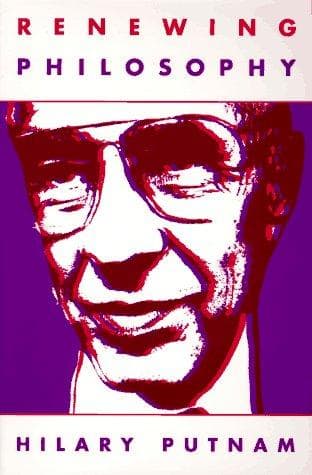
Renewing Philosophy
تجديد الفلسفة
Renouveler la philosophie
Editorial summary
This collection of lectures marks Hilary Putnam's significant intervention in the philosophy of religion debate during the early 1990s. The work emerged from Putnam's Gifford Lectures, traditionally devoted to natural theology, but here transformed into a broader philosophical meditation on the relationship between scientific naturalism and religious belief. Writing against the backdrop of logical positivism's decline and the rise of scientific materialism, Putnam challenges both crude reductionism and simplistic religious apologetics.
The monograph's central argument concerns the inadequacy of scientism - the view that natural science provides the only legitimate form of knowledge. Putnam contends that this position undermines itself, as the claim that science alone yields truth cannot itself be scientifically validated. He develops this critique through careful analysis of the fact-value distinction, arguing that even scientific practice presupposes evaluative judgments that cannot be reduced to empirical observation. This philosophical groundwork enables Putnam to create conceptual space for religious discourse without retreating into fideism or irrationalism.
Putnam engages critically with prominent atheistic philosophers, particularly those who dismiss religious language as meaningless or who reduce religious experience to neurological states. Against eliminative materialists like Paul Churchland, he argues that consciousness and intentionality resist reduction to physical processes. However, Putnam equally resists traditional natural theology, finding classical proofs for God's existence philosophically inadequate. His position represents a sophisticated middle path that acknowledges both the legitimacy of religious life and the importance of rational critique.
The work's methodology combines analytic philosophy's precision with pragmatist insights about the plurality of human practices. Putnam draws on Wittgenstein's later philosophy to argue that religious language games possess their own logic and cannot be evaluated solely by scientific criteria. This approach allows him to defend religious discourse as cognitively meaningful while avoiding commitment to specific theological claims.
The monograph's significance lies in its demonstration that neither dogmatic atheism nor uncritical theism adequately addresses the complexity of religious phenomena. By showing how scientific naturalism overreaches when it claims exclusive access to truth, Putnam opens philosophical space for taking religious experience seriously without abandoning rational inquiry. His work influenced subsequent discussions about the relationship between science and religion, particularly among philosophers seeking alternatives to both fundamentalism and reductive materialism.
Argument formulations engaged
Putnam, Hilary (1992). Renewing Philosophy.
@book{renewing-philosophy-1992,
  author    = {Putnam, Hilary},
  title     = {Renewing Philosophy},
  year      = {1992},
  url       = {https://god-database.com/en/works/renewing-philosophy-1992}
}