
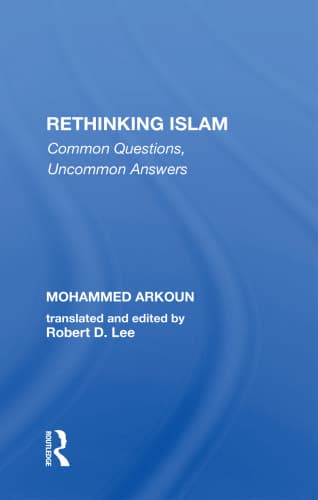
Rethinking Islam: Common Questions, Uncommon Answers
إعادة التفكير في الإسلام: أسئلة شائعة، إجابات غير مألوفة
Repenser l'Islam : questions communes, réponses peu communes
Editorial summary
This monograph represents Mohammed Arkoun's sustained effort to reconstruct Islamic thought through critical engagement with both classical Islamic tradition and contemporary Western philosophy. Arkoun develops what he terms "applied Islamology," a methodological approach that subjects Islamic texts and traditions to rigorous historical-critical analysis while remaining attentive to their lived significance for Muslim communities. The work systematically addresses fundamental questions about revelation, law, ethics, and politics in Islam through the lens of modern hermeneutics, semiotics, and anthropology.
Central to Arkoun's project is his critique of what he identifies as the "dogmatic closure" that characterizes much traditional Islamic theology. He argues that both orthodox Muslim scholars and Western Orientalists have reified Islam into a static system of beliefs and practices, obscuring the dynamic processes through which Islamic meanings are produced, contested, and transformed across different historical contexts. Against this tendency, Arkoun proposes a radical historicization of Islamic thought that would expose the contingent social and political conditions underlying claims to divine authority.
The work engages critically with several intellectual traditions. Arkoun challenges traditional Muslim theologians who assert the transhistorical validity of classical interpretations, arguing instead that all religious understanding occurs within specific "epistemes" or frameworks of knowledge that shape what can be thought and said. Simultaneously, he critiques secularist approaches that dismiss religious discourse as merely ideological, insisting on the irreducible anthropological significance of the sacred. His methodology draws extensively from French post-structuralist thought, particularly the work of Michel Foucault and Paul Ricoeur, to develop tools for analyzing Islamic texts that avoid both fundamentalist and reductionist readings.
Arkoun's contribution to debates about God lies in his reconceptualization of revelation as an ongoing hermeneutical event rather than a closed corpus of divine commandments. He argues that the Quranic text becomes revelation only through acts of interpretation that necessarily involve human creativity and fallibility. This position challenges both traditional Islamic theology's emphasis on the literal word of God and secular dismissals of religious experience. By insisting on the historically mediated character of all religious knowledge while affirming the existential importance of transcendence, Arkoun opens space for critical dialogue between Islamic thought and modern philosophy. His work demonstrates how rigorous historical analysis can serve not to undermine faith but to revitalize it through creative reinterpretation.
Argument formulations engaged
Related works
Arkoun, Mohammed (1994). Rethinking Islam: Common Questions, Uncommon Answers.
@book{rethinking-islam-common-questions-uncomm,
  author    = {Arkoun, Mohammed},
  title     = {Rethinking Islam: Common Questions, Uncommon Answers},
  year      = {1994},
  url       = {https://god-database.com/en/works/rethinking-islam-common-questions-uncommon-answers-1994}
}