
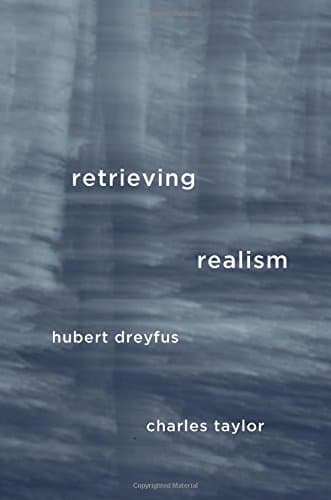
Retrieving Realism
استرجاع الواقعية
Retrouver le réalisme
Editorial summary
Charles Taylor's Retrieving Realism presents a sustained philosophical defense of direct realism against the mediational epistemologies that have dominated Western thought since Descartes. Written with Hubert Dreyfus, this monograph challenges the assumption that human beings encounter reality through internal representations, arguing instead that humans possess unmediated contact with the world through embodied perception and engaged coping.
The work systematically dismantles what Taylor calls the "mediational picture," which posits that knowledge of external reality necessarily passes through mental intermediaries such as ideas, sense data, or representations. Taylor traces this problematic framework from early modern philosophy through contemporary cognitive science, demonstrating how it generates artificial skeptical problems and distorts understanding of human agency. Against this tradition, he retrieves insights from phenomenology, particularly Heidegger and Merleau-Ponty, while also drawing on pragmatism and Wittgenstein to articulate a "contact theory" of knowledge.
Taylor's argument carries significant implications for debates about God and religious experience. By establishing that human beings can have direct, non-inferential contact with reality, he creates philosophical space for immediate awareness of transcendent realities without requiring these experiences to pass through the filters of representational consciousness. This move undermines naturalistic reductionism, which typically depends on the mediational picture to explain away religious experience as merely subjective states projected onto neutral external reality.
The monograph engages critically with influential contemporary philosophers including John McDowell, Robert Brandom, and Donald Davidson, showing how even sophisticated attempts to overcome skepticism remain trapped within mediational assumptions. Taylor argues that only a thoroughly embodied, engaged account of human existence can escape these problems. His analysis of background understanding and the conditions of intelligibility provides resources for conceiving how religious meanings can be genuinely encountered rather than merely constructed.
While not explicitly theological, Retrieving Realism opens important avenues for philosophy of religion by challenging the epistemological foundations of scientific materialism. Taylor's demonstration that the mediational picture itself rests on questionable philosophical assumptions rather than empirical discoveries weakens claims that science necessitates atheistic or purely naturalistic worldviews. The work thus contributes to creating intellectual space for robust religious realism within contemporary philosophical discourse.
Argument formulations engaged
Related works
Taylor, Charles (2015). Retrieving Realism. Harvard University Press.
@book{retrieving-realism-2015,
  author    = {Taylor, Charles},
  title     = {Retrieving Realism},
  year      = {2015},
  publisher = {Harvard University Press},
  url       = {https://god-database.com/en/works/retrieving-realism-2015}
}