
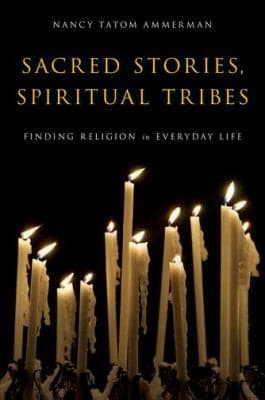
Sacred Stories, Spiritual Tribes: Finding Religion in Everyday Life
القصص المقدسة، القبائل الروحية: العثور على الدين في الحياة اليومية
Histoires sacrées, tribus spirituelles : trouver la religion dans la vie quotidienne
Editorial summary
Nancy Ammerman's Sacred Stories, Spiritual Tribes: Finding Religion in Everyday Life offers a groundbreaking empirical study of how contemporary Americans practice and understand religion beyond institutional boundaries. Drawing on extensive interviews with over 300 individuals across diverse geographic and demographic contexts, Ammerman challenges conventional sociological assumptions about secularization and religious decline by revealing the persistent presence of spirituality in everyday life.
The work's central contribution lies in its methodological innovation and conceptual reframing of religious practice. Rather than measuring religiosity through institutional affiliation or doctrinal belief, Ammerman examines how ordinary people construct meaning through what she terms "sacred stories" - narratives that connect individual experience to transcendent realities. Her analysis identifies four primary spiritual "packages" or cultural repertoires that Americans employ: theistic, extra-theistic, ethical, and belief-centered spiritualities. This typology demonstrates that even those who reject traditional religious labels often maintain robust spiritual practices and orientations.
Ammerman's research directly challenges prevailing secularization narratives, particularly those advanced by sociologists who predict religion's inevitable decline in modern societies. Against scholars who emphasize institutional disaffiliation as evidence of secularization, she reveals how spirituality persists through informal networks, personal practices, and meaning-making activities. The concept of "spiritual tribes" - loosely connected communities sharing similar approaches to the sacred - provides an alternative framework for understanding religious belonging in late modernity.
The monograph's significance for the God debate extends beyond empirical documentation to theoretical reconceptualization. Ammerman demonstrates that questions about divine existence often miss how religion actually functions in people's lives. Her subjects rarely engage in philosophical arguments about God's existence; instead, they embed sacred meanings within daily routines, relationships, and moral choices. This finding suggests that academic debates about theism may operate at considerable distance from lived religious experience.
Ammerman's careful ethnographic work illuminates the gap between elite discourse about religion's decline and grassroots spiritual vitality. By attending to how people actually talk about and practice spirituality, she reveals the inadequacy of binary categories like religious versus secular or believer versus atheist. The work thus contributes to broader conversations about post-secular society by documenting the creative ways individuals construct meaningful lives that incorporate transcendent dimensions without necessarily affirming traditional theistic claims or institutional commitments.
Argument formulations engaged
Ammerman, Nancy (2013). Sacred Stories, Spiritual Tribes: Finding Religion in Everyday Life. Oxford University Press.
@book{sacred-stories-spiritual-tribes-finding-,
  author    = {Ammerman, Nancy},
  title     = {Sacred Stories, Spiritual Tribes: Finding Religion in Everyday Life},
  year      = {2013},
  publisher = {Oxford University Press},
  url       = {https://god-database.com/en/works/sacred-stories-spiritual-tribes-finding-religion-in-everyday-life-2013}
}