
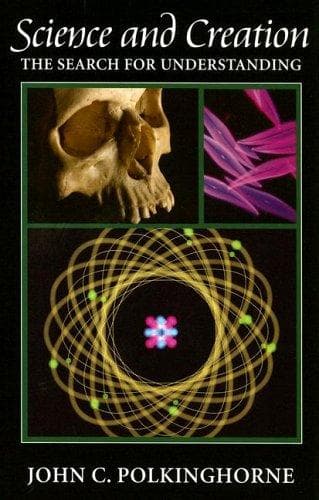
Science and Creation.. The Search for Understanding
العلم والخلق.. البحث عن الفهم
Science et création.. La quête de la compréhension
Scientific intelligibility and cosmic order are compatible with, and in some respects suggestive of, a theistic reading of reality.
Editorial summary
John Polkinghorne's "Science and Creation: The Search for Understanding" presents a sophisticated engagement with the relationship between scientific cosmology and theological doctrine, arguing that contemporary physics not only permits but actively supports belief in a divine creator. As both a theoretical physicist and Anglican priest, Polkinghorne brings a unique dual expertise to bear on questions traditionally seen as residing in separate magisteria.
The work develops its central thesis through careful examination of how the fundamental constants and initial conditions of the universe appear remarkably calibrated for the emergence of carbon-based life. Polkinghorne engages directly with the fine-tuning argument, presenting it not as a simplistic proof of divine design but as part of a cumulative case for theistic belief. He acknowledges multiverse hypotheses as potential naturalistic explanations while arguing that they represent metaphysical commitments no less substantial than theism itself. His treatment distinguishes itself from typical design arguments by grounding its claims in detailed engagement with contemporary physics rather than biological complexity.
Methodologically, Polkinghorne employs what he terms "critical realism" in both scientific and theological domains, arguing that both disciplines seek truthful accounts of reality through different but complementary modes of inquiry. This philosophical framework allows him to reject both scientistic reductionism and fideistic retreat from empirical engagement. He positions himself against both Richard Dawkins's scientific atheism and Stephen Jay Gould's non-overlapping magisteria, proposing instead a model of "consonance" between scientific and theological understanding.
The pragmatic dimensions of Polkinghorne's argument emerge in his discussion of how theistic belief provides resources for understanding why the universe proves intelligible to human minds and why mathematics proves so unreasonably effective in describing physical reality. He suggests that viewing the cosmos as divine creation offers explanatory power for features of reality that purely naturalistic accounts struggle to accommodate.
The work's significance lies in its sophisticated navigation between naive natural theology and complete theological withdrawal from cosmological questions. Polkinghorne demonstrates how one might maintain intellectual integrity as both scientist and believer, offering a model particularly relevant to contemporary debates about science and religion. His arguments have influenced subsequent discussions about divine action, the anthropic principle, and the proper relationship between empirical investigation and theological reflection.
Structured analysis
Structure of the work
Argument formulations engaged
Related works
Polkinghorne, John C. (2006). Science and Creation.. The Search for Understanding. Templeton Foundation Press.
@book{science-and-creation-the-search-for-unde,
  author    = {Polkinghorne, John C.},
  title     = {Science and Creation.. The Search for Understanding},
  year      = {2006},
  publisher = {Templeton Foundation Press},
  url       = {https://god-database.com/en/works/science-and-creation-the-search-for-understanding}
}