
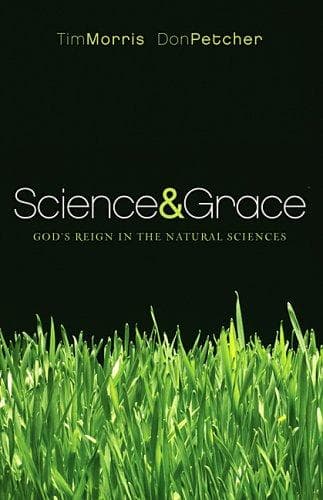
Science and Grace.. God's Reign in the Natural Sciences
العلم والنعمة.. سلطان الله في العلوم الطبيعية
Science et grâce.. Le règne de Dieu dans les sciences naturelles
God's reign, understood through the lens of grace, is not in conflict with the natural sciences but provides a theological framework within which scientific inquiry can be properly situated and understood.
Editorial summary
Morris develops a systematic theological framework demonstrating how Christian faith coheres with and illuminates contemporary scientific understanding. Writing from within the Reformed tradition, he argues that properly understood scientific inquiry reveals rather than obscures divine action in nature. His central thesis maintains that grace operates not only in redemption but fundamentally structures the natural order itself, making scientific discovery possible while simultaneously pointing beyond naturalistic explanation.
The work engages primarily with reductive naturalism and methodological materialism prevalent in contemporary philosophy of science. Morris contends these approaches unnecessarily constrain scientific interpretation by excluding theological categories a priori. He draws on Michael Polanyi's post-critical philosophy and Thomas Torrance's theological method to argue that scientific knowledge depends on grace-enabled rational intuition. Against strict empiricists, he maintains that scientists rely on faith commitments and aesthetic judgments that transcend purely material observation.
Morris constructs his positive case through careful analysis of scientific practice across multiple disciplines. In physics, he examines how fundamental constants appear fine-tuned for complexity and life, arguing this points to intentional design rather than chance or necessity. His treatment of biological systems emphasizes their irreducible complexity and information-rich structures as evidence of purposive creation. Throughout, he distinguishes his position from crude god-of-the-gaps reasoning by insisting that divine action grounds rather than interrupts natural processes.
The cumulative case strategy emerges through successive chapters demonstrating how theistic interpretation enriches scientific understanding without compromising empirical rigor. Morris shows how Christian doctrines of creation, providence, and common grace provide coherent explanations for the intelligibility of nature, the effectiveness of mathematics in physical description, and the emergence of consciousness capable of scientific reflection.
Significantly, Morris addresses the science-religion dialogue from explicitly confessional commitments while maintaining sophisticated engagement with scientific literature. He critiques both fundamentalist rejection of mainstream science and theological accommodation that evacuates divine action of real causal efficacy. His mediating position affirms methodological naturalism as a research strategy while rejecting metaphysical naturalism as a comprehensive worldview.
The work's contribution lies in demonstrating how robustly theistic conviction can engage contemporary science without retreating into fideism or capitulating to secularist assumptions. Morris provides theological resources for scientists who seek integration between their faith and professional practice while challenging non-theistic colleagues to recognize the metaphysical commitments underlying their own interpretative frameworks.
Structured analysis
Argument formulations engaged
Related works
Morris, Tim (2006). Science and Grace.. God's Reign in the Natural Sciences. Crossway Books.
@book{science-and-grace-gods-reign-in-the-natu,
  author    = {Morris, Tim},
  title     = {Science and Grace.. God's Reign in the Natural Sciences},
  year      = {2006},
  publisher = {Crossway Books},
  url       = {https://god-database.com/en/works/science-and-grace-gods-reign-in-the-natural-sciences}
}