
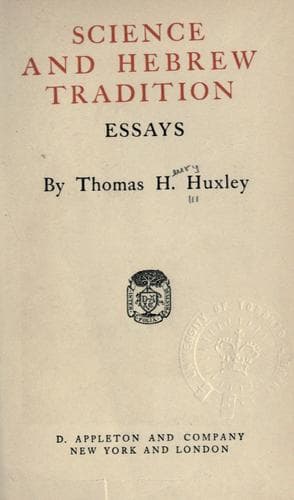
Science and Hebrew Tradition
العلم والتقليد العبري
Science et tradition hébraïque
Editorial summary
Thomas Henry Huxley's Science and Hebrew Tradition represents a significant Victorian intervention in the conflict between biblical literalism and scientific naturalism. This collection of essays systematically examines Hebrew scriptural narratives through the lens of nineteenth-century scientific methodology, challenging traditional religious authority while establishing the epistemological superiority of empirical investigation.
Huxley directs his critique primarily at contemporary biblical literalists and Christian apologists who maintain the historical accuracy of Old Testament accounts. His approach combines textual criticism with geological, archaeological, and biological evidence to demonstrate fundamental incompatibilities between Hebrew cosmogony and scientific understanding. The work particularly scrutinizes the Genesis creation narrative, the Noachian deluge, and Mosaic chronology, arguing that these texts reflect pre-scientific worldviews rather than divine revelation.
The collection's philosophical significance extends beyond mere biblical criticism. Huxley articulates a comprehensive naturalistic epistemology that privileges empirical observation over revealed truth claims. He argues that scientific method provides the only reliable pathway to knowledge, while religious tradition perpetuates demonstrable errors through appeal to supernatural authority. This position situates him within the broader Victorian scientific naturalism movement, alongside figures like John Tyndall and Leslie Stephen, who sought to liberate intellectual inquiry from theological constraints.
Huxley employs what he terms "agnostic" methodology, though his agnosticism functions more as methodological naturalism than genuine suspension of judgment. He contends that questions about ultimate causation or divine existence lie beyond scientific purview, yet simultaneously argues that naturalistic explanations sufficiently account for all observable phenomena. This tension reveals the work's implicit atheistic trajectory, despite Huxley's careful avoidance of explicit atheist identification.
The essays' enduring contribution to philosophy of religion lies in their articulation of the conflict thesis between science and religion. While later scholarship has complicated this narrative, Huxley's formulation profoundly influenced subsequent debates about religious epistemology, biblical hermeneutics, and the cultural authority of science. His insistence that religious texts must submit to scientific scrutiny established a framework for naturalistic biblical criticism that continues to shape contemporary discussions.
Science and Hebrew Tradition thus functions as both historical document and philosophical argument, demonstrating how Victorian scientific naturalism deployed empirical methodology to undermine traditional religious authority while establishing science as the privileged arbiter of truth claims about the natural world.
Argument formulations engaged
Related works
Huxley, Thomas Henry (1893). Science and Hebrew Tradition. Gorgias Press.
@book{science-and-hebrew-tradition-1893,
  author    = {Huxley, Thomas Henry},
  title     = {Science and Hebrew Tradition},
  year      = {1893},
  publisher = {Gorgias Press},
  url       = {https://god-database.com/en/works/science-and-hebrew-tradition-1893}
}