
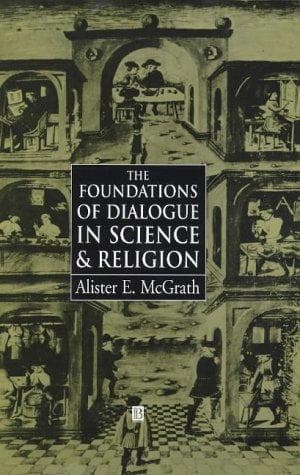
Science and Religion.. An Introduction
العلم والدين.. مقدمة
Science et religion.. Une introduction
Science and religion are not inherently in conflict but represent complementary modes of inquiry, and theism provides a coherent intellectual framework that accommodates and enriches scientific understanding.
Editorial summary
McGrath's monograph presents a comprehensive introduction to the science-religion dialogue from a distinctly Christian perspective, employing analytical philosophical methods to examine the intellectual interface between scientific and theological inquiry. The work systematically addresses fundamental questions about the compatibility of scientific knowledge with religious belief, particularly Christian theism, while engaging with contemporary debates in philosophy of science.
The author develops his argument through careful examination of historical and conceptual relationships between scientific and religious thought. McGrath challenges the prevalent conflict thesis, arguing instead that science and religion represent complementary approaches to understanding reality. His methodology draws extensively from philosophy of science to demonstrate how both domains employ distinct but equally valid epistemic frameworks. The work particularly emphasizes how scientific discoveries, rather than undermining religious belief, can provide supportive evidence for theistic worldviews.
Central to McGrath's argument is his engagement with the fine-tuning argument, which he presents as a significant point of convergence between scientific observation and theological reflection. He examines how the precise calibration of physical constants necessary for life suggests purposeful design rather than random chance. This discussion connects to broader cumulative case arguments, where McGrath assembles multiple lines of evidence from cosmology, biology, and human consciousness that collectively point toward theistic conclusions.
The reason and rationality argument receives substantial treatment as McGrath explores how the intelligibility of the universe and human capacity for scientific reasoning align with expectations of a created order. He contends that the remarkable correspondence between mathematical abstractions and physical reality, along with the reliability of human cognitive faculties in discovering truth, finds more satisfactory explanation within a theistic framework than naturalistic alternatives.
McGrath's contribution lies in his balanced yet committed approach to contentious issues. While clearly advocating for the intellectual credibility of Christian theism, he acknowledges legitimate scientific autonomy and avoids simplistic harmonization schemes. The work serves as both an accessible introduction for newcomers and a sophisticated defense of theistic perspectives in science-religion discourse. His engagement with critics of religion, particularly scientific materialists, remains scholarly and substantive throughout, establishing common ground where possible while clearly articulating points of divergence.
Structured analysis
Structure of the work
Argument formulations engaged
Related works
McGrath, Alister (1999). Science and Religion.. An Introduction.
@book{science-and-religion-an-introduction,
  author    = {McGrath, Alister},
  title     = {Science and Religion.. An Introduction},
  year      = {1999},
  url       = {https://god-database.com/en/works/science-and-religion-an-introduction}
}