
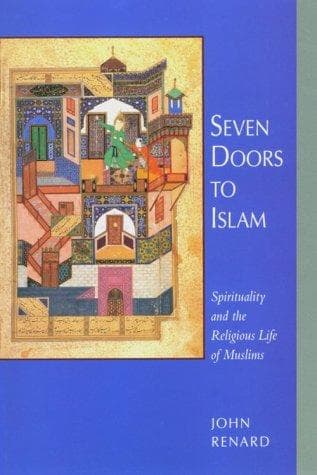
Seven Doors to Islam: Spirituality and the Religious Life of Muslims
سبعة أبواب إلى الإسلام: الروحانية والحياة الدينية للمسلمين
Sept portes vers l'Islam : Spiritualité et vie religieuse des musulmans
Editorial summary
This monograph presents a comprehensive examination of Islamic spirituality through seven thematic "doors" that structure Muslim religious experience. Renard employs a phenomenological approach that privileges internal religious meanings over external scholarly categorization, drawing extensively from primary sources including Quranic exegesis, hadith literature, mystical texts, poetry, and devotional materials spanning fourteen centuries of Islamic tradition.
The work organizes Islamic spirituality into seven interconnected dimensions: foundations (Quran and hadith), prophetic paradigms, devotion and prayer, theological aesthetics, community structures, mystical experience, and eschatological hope. Rather than treating these as discrete categories, Renard demonstrates how they form an integrated system of religious meaning. His analysis reveals how Muslims across diverse historical and geographical contexts have understood their relationship with the divine through practices, narratives, and interpretative traditions that transcend sectarian boundaries.
Methodologically, the text bridges religious studies and Islamic studies by combining textual analysis with attention to lived religious experience. Renard draws from both classical sources and contemporary ethnographic accounts, presenting Islam as a dynamic tradition rather than a static system. His approach challenges reductionist accounts that separate "orthodox" from "popular" Islam or isolate Sufism from mainstream practice. Instead, he demonstrates how mystical, legal, theological, and devotional elements interweave throughout Islamic history.
The monograph's contribution to understanding God in Islamic context lies in its presentation of divine-human encounter as multifaceted and experientially rich. Renard shows how Islamic conceptions of God emerge through scriptural interpretation, prophetic models, ritual practice, aesthetic expression, communal bonds, mystical states, and eschatological anticipation. He emphasizes the tradition's internal diversity while identifying unifying themes around divine transcendence and immanence, prophetic mediation, and transformative spiritual practice.
For scholars of religion, the work provides a methodological model for studying theistic traditions from within their own conceptual frameworks while remaining analytically rigorous. Renard's phenomenological sensitivity combined with historical breadth offers insights into how monotheistic spirituality functions as lived reality rather than abstract doctrine. The text serves both as an introduction to Islamic religious life and as a sophisticated analysis of how Muslims have historically conceived and experienced the divine presence. His treatment illuminates the complexity of Islamic spirituality while maintaining accessibility for non-specialist readers seeking to understand Muslim approaches to the sacred.
Argument formulations engaged
Related works
Renard, John (1996). Seven Doors to Islam: Spirituality and the Religious Life of Muslims. University of California Press.
@book{seven-doors-to-islam-spirituality-and-th,
  author    = {Renard, John},
  title     = {Seven Doors to Islam: Spirituality and the Religious Life of Muslims},
  year      = {1996},
  publisher = {University of California Press},
  url       = {https://god-database.com/en/works/seven-doors-to-islam-spirituality-and-the-religious-life-of-muslims-1996}
}