
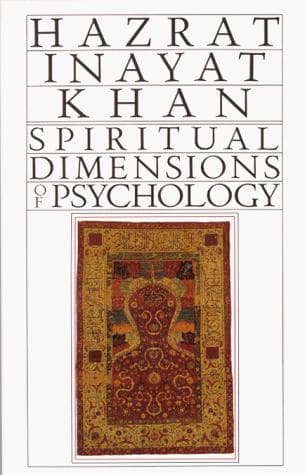
Spiritual Dimensions of Psychology
الأبعاد الروحية لعلم النفس
Les dimensions spirituelles de la psychologie
Psychological life has an irreducible spiritual dimension, and genuine self-knowledge ultimately opens onto an awareness of a divine reality that transcends the merely material.
Editorial summary
This monograph examines the intersection between psychological phenomena and spiritual experience, arguing that modern psychology's materialist framework inadequately accounts for dimensions of human consciousness that point toward transcendent reality. Khan develops a synthetic approach that draws from both Western psychological theory and Eastern contemplative traditions, particularly Sufism, to construct what he terms a "spiritual psychology" that acknowledges divine presence within human consciousness.
The work engages primarily with early twentieth-century psychoanalytic theory, positioning itself as both a critique and expansion of Freudian and Jungian frameworks. While acknowledging psychology's contributions to understanding mental processes, Khan argues that its reductionist tendencies eliminate crucial aspects of human experience that traditional spiritual systems have long recognized. He contends that phenomena such as mystical states, intuitive knowledge, and experiences of unity cannot be adequately explained through purely materialist or biological models of consciousness.
Khan's methodology combines phenomenological description of spiritual experiences with comparative analysis of psychological and mystical literature. He examines case studies of individuals reporting transcendent experiences, analyzing these through both psychological and spiritual interpretive lenses. This dual approach allows him to demonstrate what he sees as the limitations of purely secular psychological explanation while proposing an expanded framework that incorporates divine action within human consciousness.
The work's central argument rests on the claim that consciousness itself provides evidence for divine reality. Khan posits that certain capacities of human awareness - particularly those involving direct intuitive knowledge, experiences of cosmic unity, and states of expanded consciousness - cannot emerge from purely material processes. He suggests these phenomena indicate the presence of a divine element within human nature, making consciousness a bridge between material and spiritual dimensions of existence.
While maintaining a respectful dialogue with secular psychology, Khan ultimately advocates for a theistic understanding of human nature that sees psychological health as inseparable from spiritual development. His contribution lies in attempting to create conceptual space within psychological discourse for acknowledging transcendent dimensions of experience without abandoning empirical observation. The work represents an early effort to bridge scientific psychology with perennial philosophy, anticipating later developments in transpersonal psychology while maintaining explicit theistic commitments throughout its analysis.
Structured analysis
Argument formulations engaged
Khan, Hazrat Inayat (1981). Spiritual Dimensions of Psychology.
@book{spiritual-dimensions-of-psychology,
  author    = {Khan, Hazrat Inayat},
  title     = {Spiritual Dimensions of Psychology},
  year      = {1981},
  url       = {https://god-database.com/en/works/spiritual-dimensions-of-psychology}
}